
More than a history, that of the Pantheon is a journey through time. If you are interested in doing it with us, this is a good place to start, to trace the history of a nearly 2,000-year-old monument.
Mark this date: 27 B.C. It all began then with Marcus Vipsanius Agrippa and Octavian Augustus. It is a smaller temple in size, but it is dedicated to the planetary deities of Rome.
Pliny the Elder has an insight: he calls it Pantheon, that is, temple of all gods, Greek style. And so it passes into History, even when this Pantheon is destroyed by a couple of fires and an emperor decides to build another one. The one that has come down to us.
The barbarians arrive, the Empire collapses, the Middle Ages begin, but the Pantheon endures. Phocas, Byzantine emperor, gives it to the pope. The pope converts it into a Christian church and saves it from the stripping, abandonment, and collapse that did not spare even the Colosseum.
But in the Renaissance, the Pantheon … was reborn throughart and culture. The Basilica of Santa Maria ad Martyres, “La Rotonda” as the people call it, becomes the tomb of the great artists of the time and of later eras.
But there is more to know, and we will help you discover it. We will talk about the restorations, but also about some improvised ideas that almost changed its face.
We will go through theModern Age to get to the Risorgimento, which made the Pantheon a monument to celebrate the birth of the Kingdom of Italy, with the first crowned heads of the House of Savoy resting here for eternity.
Following a timeline from the Roman Empire to the present day, you will discover how and why the Pantheon, a World Heritage Site, has been able to fend off the attacks of time with majestic indifference.
And now it waits to reveal all its secrets to you.
WARNING If you would like to visit the Pantheon in Rome, we recommend that you purchase tickets online to avoid the risk of finding them sold out or waiting in long lines. Click below and book your visit now.

Best Selling Ever
Pantheon of Rome: Quick Access Ticket + Official Audio Guide
Quick access and audio guide included: discover the history of the Pantheon and admire the famous dome and oculus.
Secure payment
Instant confirmation
Mobile ticket
The timeline of Rome’s Pantheon
- 27 BC: Marcus Agrippa builds the Temple of All Gods in honor of Augustus
- 80 AD: First fire of the Pantheon
- 110 AD: Second fire of the Pantheon
- 118-128 AD: Hadrian rebuilds the Pantheon
- 2nd-3rd century AD: First restorations under Antoninus Pius and Septimius Severus
- 476 AD: Fall of the Roman Empire
- 608: Byzantine emperor Phocas gives the Pantheon to the pope
- 609: Boniface IV converts it into a Christian church: Basilica of Santa Maria ad Martyres
- 663: Removal of the bronze tiles of the dome
- 1000 (approx.): People begin to refer to the Pantheon as “La Rotonna”
- 1460: Melozzo da Forli paints the fresco of the Annunciation
- 1520: Death of Raphael Sanzio and creation of his tomb at the Pantheon
- 1625: Pope Urban VII Barberini removes the bronzes from the portico and builds the two bell towers
- 1662: Pope Alexander VII restores the marbles of the colonnade
- 1774: Restorations in the cella clindrica
- 1833: Reconnaissance of Raphael’s tomb
- 1883: Demolition of Bernini’s bell towers, the “donkey ears”
- 1878, 1900, 1926: Burials of the first royals of the house of Savoy
- 1980: Unesco inserts the Pantheon with the Historic Center of Rome as a World Heritage Site
- july 2023: Introduction of paid ticket to visit the Pantheon
Brief history of the Pantheon
The history of the Pantheon begins in 27 B.C., when Marcus Vipsanius Agrippa, friend, collaborator, and later also son-in-law of Octavian Augustus, built in just 2 years, and at his own expense, a temple dedicated to the planetary deities of Rome.
The original temple suffered a first fire in 80 CE and a second, possibly caused by lightning, in 110: two events that undermined the building’s integrity and splendor.
Vespasian and Trajan commissioned restoration work, but it was Emperor Hadrian who determined to rebuild it from scratch, entrusting the project to the archistar of the time:Apollodorus of Damascus. The issue, however, is debated.
In 608 the Byzantine Emperor Phocas gives it to Pope Boniface IV, who in 609 reconverts the Hadrianic temple into a Christian church, Santa Maria ad Martyres. It is the salvation of the Pantheon.
Since the Renaissance, Hadrian’s temple or, as it was called at the time, the Basilica of Santa Maria ad Martyres, began to house the tombs of distinguished Italian men.
First to be buried there is the genius of painting Raphael Sanzio. The last, in a chronological sense, are Italy’s first royals Victor Emmanuel II his son Umberto I and his consort, Margaret of Savoy.
Since 1980 the entire Historic Center of Rome, and consequently also the Pantheon, has been a Unesco World Cultural Heritage Site.
A place of Catholic worship open to the devotion of the faithful, it is also a place of worship for millions of visitors attracted by its uniqueness and primacy.
As of 2023, the Ministry of Culture, which owns the property and manages it with the Cardinal Vicar of Rome, has determined that access to the monument is no longer free.
Buying a ticket online and skipping the line is a demonstration of practical sense that even ancient Romans would have loved.
Detailed history of the Roman Pantheon
Interesting, isn’t it? Wait until you delve deeper into the history of the Pantheon and see how many stories there are to tell!
There are all the ingredients for a successful tale: myth, birth, fall, rebirth, world fame. The Pantheon of Rome knows how to amaze you no matter what era you wish to consider.
We, not to be mistaken, propose them all.
Find out the most important historical facts now.
The Pantheon of Agrippa
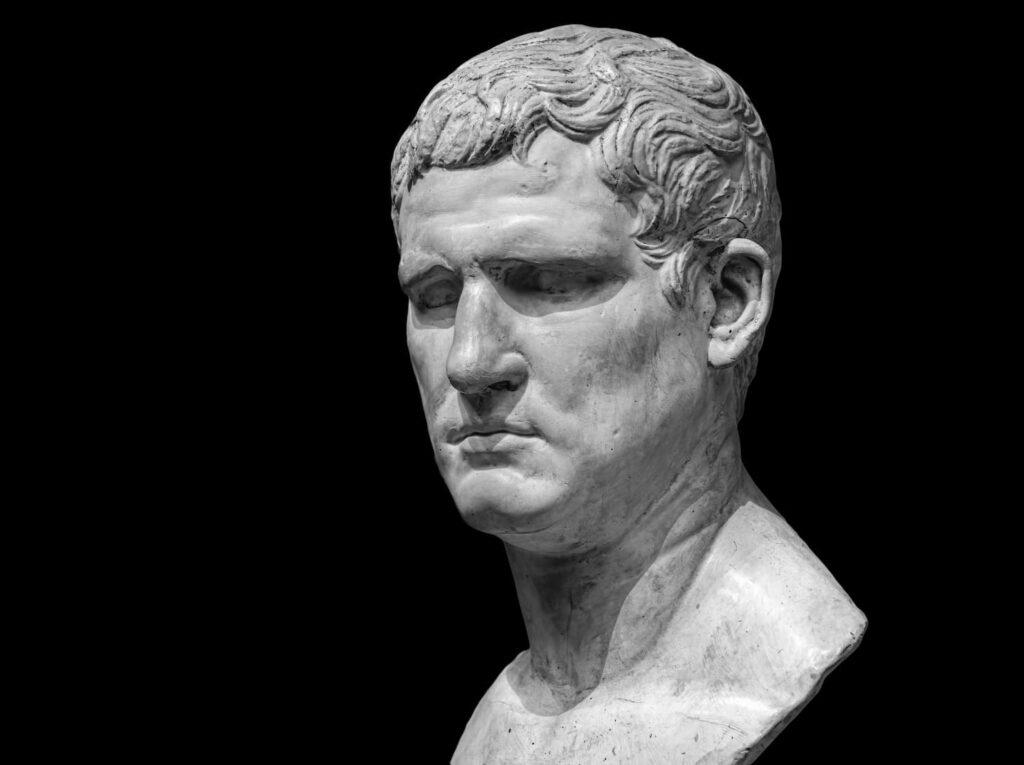
ID 234848679 © Ruslan Gilmanshin | Dreamstime.com
For more than 19 centuries, the Pantheon in Rome has fascinated and amazed with its majestic harmony. But the history of the temple, as we see it today, begins before 128 AD.
The Pantheon stands in what is now the Rione Pigna. You are walking through the historic center of Rome, a UNESCO World Heritage Site, in the ancient Campus Martius, the exact spot where, according to legend, the ascension to heaven of Romulus, the founder of the Eternal City, took place.
And it was exactly here that, seven centuries later, Marcus Vipsanius Agrippa, Augustus’ collaborator and son-in-law, would build in his honor the temple dedicated to the seven planets deified by the Romans: the Sun, Moon, Jupiter, Saturn, Mars, Venus and Mercury .
Work began in 27 B.C., a date that actually marks the beginning of the Roman Empire, and was completed in a couple of years.
It was directed by Lucius Cocceus Aucto, an engineer and architect who had come to prominence for building infrastructural works in Naples and Cumae, where he was originally from.
Agrippa’s Pantheon must have been smaller than the one that would rise in the second century AD. Its estimated dimensions are about 44 meters wide and nearly 20 meters long.
Archaeological studies dating back to the mid-19th century suggest that the Augustan Pantheon had a rectangular plan, and that the cell, placed crosswise, was wider than long.
It was built of travertine blocks covered with marble, had a pitched roof like many other Roman public and religious buildings, and was oriented to the south, the opposite of what we admire today.
Moreover, Agrippa’s Pantheon was embedded in an urban context that included the Saepta Iulia and the Basilica of Neptune. The latter stood opposite the Augustan temple and was separated from it by a circular esplanade, probably porticoed.
Pliny the Elder and Cassius Dione
The only ancient source on the Pantheon built in the Augustan age is Pliny the Elder.
The author, who disappeared in theeruption of Mount Vesuvius in 64 A.D., made time to see it “live,” and in the Naturalis Historia he mentions the caryatids of Diogenes of Athens, the frontal statues, and the Syracusan bronze capitals.
Pliny the Elder is also credited with the invention of the word Pantheon or Pantheum, having brought into the Latin lexicon the original Greek term Pántheion Hierón, τό Πάνθειον (ἱερόν), meaning precisely Temple of all gods.
Another ancient source that mentions the Pantheon, Cassius Dione, active in the late second and early third centuries. The Greek-speaking Latin historian and politician speculated that the origin of the name depended on the presence of many statues of gods or perhaps on the fact that the Dome was a reproduction of the vault of heaven.
What he is talking about, however, is already the Pantheon of Emperor Hadrian who reigned from 117 to 138.
Hadrian’s Pantheon
The Augustan Pantheon suffered a pair of fires, one in 80 and one in 110 A.D. (the latter possibly caused by lightning) that compromised its stability.
Several emperors undertook to restore the temple to its original splendor. Scholars speak of restorations occurring under Trajan, but it was not until Hadrian that Rome saw the “new” Pantheon rise. “Our,” Pantheon.
The monument we can admire in all its splendor and of which we shall speak from now on is the building with the cylindrical cell inside, the Rotunda, which housed the statues of all the past, present and future gods of imperial Rome.
It is the temple with the Avancorpus, the physical and symbolic link between the human sphere and the celestial sphere symbolized by the Rotunda and the Dome. The largest ever built in the world in unreinforced concrete.
It is the architectural masterpiece illuminated by the sunlight filtering through the Oculus, which then revealed the statues of the gods. The same light that now rests on the great Italians who rest for eternity within it.
The dating of the Pantheon
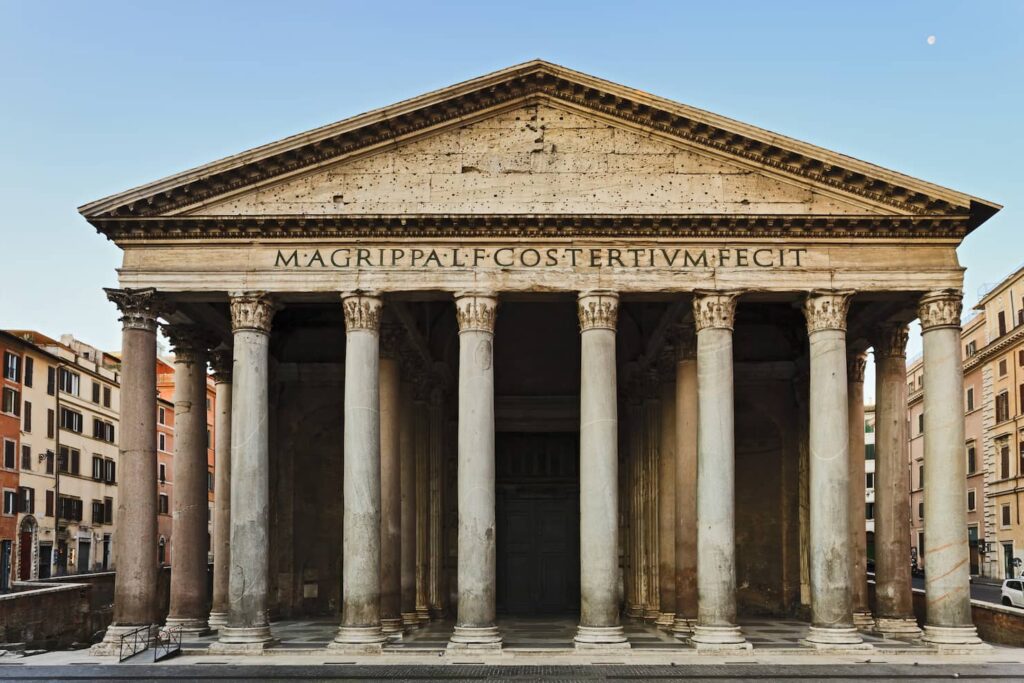
ID 33051846 | © Taras Vyshnya | Dreamstime.com
The precise dating of the Pantheon in Rome is uncertain, but the most accepted studies pinpoint the completion of the work between 125 and 128.
This would also be proved by most of the brick stamps, the factory marks bearing the year of production affixed to the surface of the building bricks, found mainly in the inner cell.
During the Roman Empire , life in the Pantheon was all in all quiet. The otherwise minor restorations carried out under the emperors Antoninus Pius and Septimius Severus, in the second and early third centuries, respectively, are well known.
The temple survived the barbarian invasions and the establishment of Christianity as the official religion in Rome. Luck, in this case, played an important role.
The Middle Ages
If you are wondering how it was possible that the Pantheon, unique among the works of Roman antiquity, has come down to us virtually intact, the answer is that this pagan temple was converted back into a Christian church.
In the year 608, the Eastern Roman emperor, Phocas, donated the Pantheon to Pope Boniface IV who, a year later, converted it into a church , the first to be consecrated by a pagan place of worship. Another record of the Pantheon of Rome.
The new church was renamed Santa Maria ad Martyres, in Italian Santa Maria dei Martiri, in honor of the remains of witnesses to the Christian faith.
As mentioned, the transformation preserved the Pantheon from the destruction and depredations suffered by other pagan-era monuments, but it did not save it from the removal of the bronzes of the Dome and Pronaos.
It took place in two stages. The first time by order of the Byzantine emperor Constant II in 663. The second 1,000 years later at the behest of a pope, as we shall see. It was not until 733 that the Dome of the Pantheon in Rome had a new lead covering, thanks to Pope Gregory III.
Around the year 1000 the church took on a new poular name: Santa Maria Rotunda, and by extension the square and the streets that converged on it were also called “Rotonna,” Rotunda.
From the 14th century, the Pantheon became a gymnasium of art. The first and most famous fresco is the Annunciation by Melozzo da Forli dating from 1460. In the following centuries it would become a shrine for great artists and Italian crowned heads.
However, during the Avignon Captivity of the popes (1378-1417) the Pantheon was used as a fortress, witnessing the struggles between the Colonna and Orsini families.
When Gregory XI, under pressure from St. Catherine of Siena, brought the Holy See back to Rome, the Pantheon and its area experienced a first phase of restoration. Thus, the bases of the columns of the Portico returned to light and the square was freed from the rubble of the hovels that had been built there.
The Renaissance
Since the 16th century the history of Rome’s Pantheon has been intertwined with that of Art History and its great Italian masters. Foremost among them is Raphael Sanzio.
With the rebirth of arts and culture in Italy, there is a parallel transformation of the atmosphere of the Pantheon’s interiors in Rome.
The trend is evident: without distorting the overall structure of the architecture, the character as a place of Christian worship is increasingly accentuated.
Death reached Raphael prematurely on April 6, 1520, on Good Friday at only 37 years of age.
The Urbino, however, made it in time to commission from his pupil and friend Lorenzetto, his own tomb and the Statue of the Madonna del Sasso that serves as a landmark for visitors to locate the tomb.
Raphael’s fame attracted some of the greatest artists of his and the immediately succeeding era to Rome. Their activities were intertwined with the history of the Pantheon.
Two of the Urbinate’s pupils answered the call: Perin del Vaga and Giovanni da Udine. But also Annibale Carracci, one of the fathers of Baroque painting, and Baldassarre Peruzzi, who exercised his genius from painting to architecture, from stage design to military engineering.
They all rest in the Pantheon for eternity, at the time the most sought-after memorial for artists. And it is no accident that in 1543, under Pope Paul III Farnese, the Congregation of the Virtuous at the Pantheon, later the Pontifical Academy of Fine Arts, was born.
Thanks to this institution, the Pantheon of Rome “acquired” another vocation: that of a gallery and venue for art exhibitions with an intense cultural life that flourished until the end of the 19th century.
The best-selling
Pantheon of Rome: Quick Access Ticket + Official Audio Guide
Quick access and audio guide included: discover the history of the Pantheon and admire the famous dome and oculus.
Secure payment
Instant confirmation
Mobile ticket
The Modern Age
Following in the footsteps of Gregory XI, Pontiff Alexander VII in 1663 also continued the work of thinning out what was superfluous oppressing Rome’s Pantheon.
He ordered the demolition of the crumbling Roman-era triumphal arch and a number of medieval buildings that insisted on the square, and restored the Pronao colonnade.
A few decades before him, however, the interventions made by Pope Urban VIII Barberini left the Roman people and nobility bewildered.
Under Urban VIII, the Pantheon saw the removal of the bronze beams of the Pronao and Avancorpo. They made 80 cannons out of them for Castel Gandolfo, and perhaps some of those bronzes also served Gian Lorenzo Bernini to make the Baldachin of St. Peter’s.
But that is not all. The same pope commissioned, again from Bernini, the construction of 2 Baroque bell towers on the sides of the Avancorpo to emphasize the religious character of the Pantheon.
The Romans did not take it well and renamed them the “donkey ears,” which were removed only in the late 19th century.
Pasquino, the talking statue and critical conscience of Rome, would sentence, “Quod non fecerunt barbari, fecerunt Barberini.” What the Barbarians did not do, the Barberini did.
The contemporary age
During the 18th and 19th centuries the Pantheon in Rome had a quiet life. In 1774 restorations are made in the cella at the behest of Pope Benedict XIV, while under Pius IX more thinning work is carried out in the surrounding area.
In 1833 an event that has the Pantheon as its setting captures the attention of world public opinion. And it held everyone in suspense.
The Sodalizio Artistico dei Virtuosi, the current Pontifical Academy of the Virtuosi at the Pantheon, promoted a project to survey Raphael’s tomb, entrusting its execution to the sculptor Giuseppe De Fabris, who was also the regent of the congregation of the Virtuosi.
Although Vasari had attested to its burial in the Basilica of Santa Maria ad Martyres, several hypotheses had emerged over the centuries.
That the Urbinate was buried in the nearby Santa Maria sopra Minerva. That the sarcophagus was empty. That the bones were not Raphael’s.
The riddle is solved by De Fabris on September 14, before a large crowd of curious onlookers and enthusiasts. There are bones in the sarcophagus. The Tiber floods have broken them up, but they are really Raphael’s remains.
The Pantheon is making waves again. And even more so after the Unification of Italy, proclaimed on March 17, 1861 in Turin and completed on September 20, 1870, with the taking of Porta Pia. The Savoy moved the capital of the newly formed kingdom to Rome.
Decisions affecting the Pantheon are now made by the Italian government. In 1878, the body of the first king and “Father of the Fatherland,” Victor Emmanuel II, is displayed and interred at the Pantheon.
He will be the first of 3 members of the House of Savoy. He would be followed by his son Umberto I, killed in Monza in July 1900 by the anarchist Gaetano Bresci, and Margaret of Savoy, the first queen consort, buried here in 1926.
Also in 1883, the then Minister of Public Education, Guido Baccelli, in addition to restoring the bronze letters of the dedication to Agrippa, promoted a long-awaited work: the demolition of Bernini’s bell towers and the demolition of all those buildings that prevented the proper enhancement of Rome’s Pantheon.
The present day
Today in the Basilica of St. Mary ad Martyres all religious services prescribed by the Catholic rite are celebrated.
In addition, it is the only church in Rome, apart from the four papal basilicas of St. Peter’s, St. John Lateran, St. Mary Major and St. Paul Outside the Walls, to be governed by a chapter composed of 12 full and six honorary priests.
Owned by theItalianstate , the Pantheon of Rome is managed by the Ministry of Culture and the Cardinal Vicar of Rome.
As of July 3, 2023, visiting the Pantheon is no longer free. Access is subject to thepurchase of a ticket.
Although the cessation of free admission has reduced visitor attendance, the Pantheon of Rome remains one of the most powerful and magnetic attractions in the Eternal City, a symbol of the architecture and engineering of imperial Rome.
Intermittently a place of prayer and worship for nearly 2,000 years, the Pantheon, listed with the entire historic center of Rome as a UNESCO World Heritage Site since 1980, continues to defy time with its harmonious lines.
Historical trivia
To the legends and curiosities of the Pantheon we will edit a separate article. In this one, however, we anticipate you something with a historical theme. We are sure you will find them interesting.
Let’s talk about etymology, an architect and an emperor who couldn’t stand each other, an obelisk, a pope buried by a talking statue, a king and a hero who “happened” to be in these parts.
What do you say? Shall we move on?
Pliny and the linguistic cast
Pantheon means temple of all gods. The word has Greek origins(Pántheion Theión), but it came into our language through a Latin historian, Pliny the Elder.
It was he who created the linguistic cast Pantheon or Pantheum that later passed into our and other modern languages. Today by Pantheon, if we use the capital letter, we refer to the temple in Rome.
By the lower case letter, however, we refer to the set of deities of a people or culture, but also to the shrine of the most important personalities of a nation.
The Obelisk in the Square
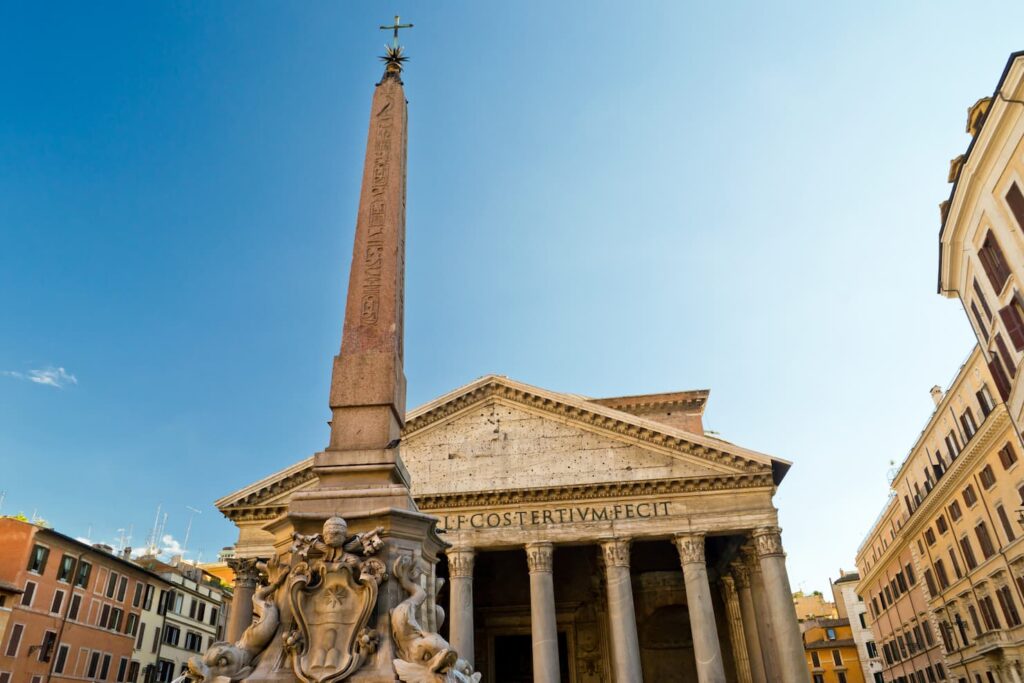
D 27855820 © Scaliger | Dreamstime.com
In Rotunda Square there is an Obelisk. Nice and tall, too: almost 6 meters. At its foot is an 18th-century fountain, commissioned by Pope Clement XI, with 4 dolphins on either side.
The Pantheon’s fame and bulk overshadow it, but it is an archaeological find of great importance. It comes from Egypt, dating from the time of Rameses II, the Pharaoh of the Battle of Kadesh and the biblical Red Sea episode.
How it came to Rome is not known. They found it, along with a twin obelisk, under the church of Santa Maria Sopra Minerva, where the temples of Isis and Osiris once stood.
Something noble was needed to complete the restyling of the square. So they moved it here from the church of San Macuto.
Barbari Barberini
“What the Barbarians did not do, the Barberini did.” So ruled Pasquino, the talking statue and critical conscience of a Rome that was. The facts are unequivocal.
Pope Urban VIII Barberini had the Pronao bronzes dismantled to build the cannons of Castel Sant’Angelo, and what was left over was used by Bernini for the Baldachin of St. Peter’s.
As if that were not enough, he imposed, again on Bernini, to erect two bell towers on either side of the Avancorpo del Pantheon. The pontiff wanted the Pantheon to resemble a real basilica, but the people did not like the effect.
They becamethe “donkey ears” of the Rotunda. A couple of centuries later they were demolished. However,“Quod non fecerunt Barari, fecerunt Barberini.”
Apollodorus and Hadrian: a relationship ended badly
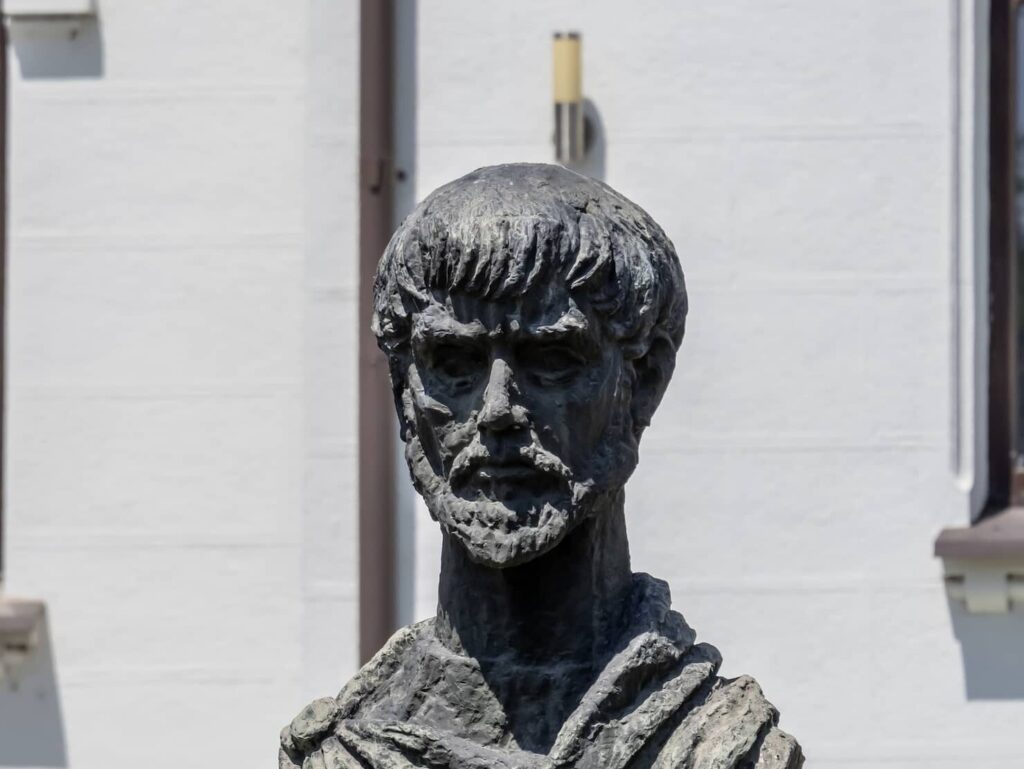
ID 389560931 © Paulmalaianu | Dreamstime.com
Apollodorus of Damascus, archistar of the imperial age, is thought to have designed the Pantheon in Rome. Thorny issue: authorship never proven.
He was the favorite of Trajan, Hadrian’s adoptive father, but with the emperor who rebuilt the Pantheon there was never a good feeling. On the contrary.
Everything began to go historical when Apollodorus, in Trajan’s presence, turned Hadrian away from a construction site. In a nutshell, he told him that he understood nothing about architecture and had better leave.
Hadrian, who is known to have a good memory, did not forget the insult, and when Apollodorus criticized the proportions of the statues in the Temple of Venus, over which the emperor had had a say, the situation precipitated.
Apollodorus was forced into exile and then was assassinated. Had he been more diplomatic, perhaps, the Pantheon inscription would have his name on it. It is only a hypothesis.
The King of Italy and the hero of two worlds
Going“er giro de Peppe” is a saying that basically means to go around in circles taking forever to get from one place to another.
The phrase originated at the funeral of Victor Emmanuel II. It seems that Giuseppe Garibaldi got caught up in the crush and followed the casket for a couple of turns around the Pantheon.
Then the first ruler of united Italy, the Father of the Fatherland to whom Rome also raised the Vittoriano, was buried in the Basilica of Santa Maria ad Martyres and still rests there.
Garibaldi did not. He was anticlerical and the Vatican opposed him. For the hero of two worlds, better the silence of Caprera.
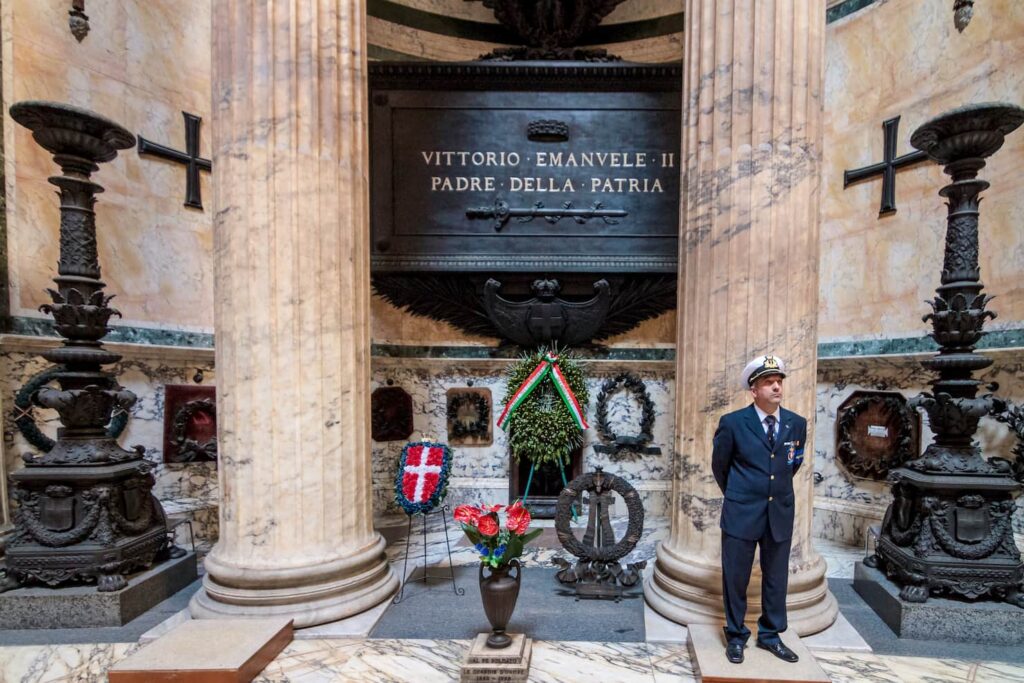
The Pantheon of the Savoy
ID 39327189 | © Andreas Zerndl | Dreamstime.com
The French had one in Paris as early as 1789. The fledgling kingdom of Italy was also to have its own pantheon. Agostino Depretis, Italy’s prime minister, was firmly of it when Victor Emmanuel II died in 1878.
The ideal solution was the Pantheon, the Basilica in Piazza della Rotonda. It was a monument with 2,000 years of history, not the church of St. Genevieve transformed for the purpose.
The Hadrianic Pantheon had the physical of the role to become the new official shrine of the royal house in place of the Basilica of Superga in Turin.
Here the threads of history could be reconnected. The Savoy family as successors to the ancient emperors of Rome, which was the new capital of Italy. Only their son Umberto I and his consort, Queen Margherita were later buried here. History took another direction.
FAQ
Pantheon is a Greek word passed into the Roman lexicon by Pliny the Elder. It means “temple of all gods,” originally the 7 planetary deities. Today by extension the word pantheon also designates the tombs of distinguished personalities.
Holes in the floor, 22 in all, allow rainwater entering from the Oculus to drain away quickly.
Technically, this opening over 9 meters in diameter is the Pantheon’s lighting system, but it is also an ingenious way to lighten the weight of the Dome, create spectacular light effects and serve the function of a solar calendar.
The Pantheon today houses the tombs of illustrious Italians, such as Raphael Sanzio, Victor Emmanuel II, Umberto I, and Queen Margaret. It is to all intents and purposes a Christian basilica where all Catholic rite services are held.
Conclusions
You have traversed 19 centuries with us, meeting emperors and popes, kings, queens and artists who have linked their history to that of a monument that has defeated time and made them immortal.
Following its line, we started from Republican Rome and went through the imperial age.
We saw the pagan temple transform into a Christian basilica in the Middle Ages and establish itself in the golden ages of papal Rome as a source of inspiration for the great artists of the Renaissance, Baroque and later eras.
Now they rest in the quiet of its niches, next to the first sovereigns of Italy. As if to tell us more about themselves and this extraordinary place.
The best-selling ever
Pantheon of Rome: Quick Access Ticket + Official Audio Guide
Quick access and audio guide included: discover the history of the Pantheon and admire the famous dome and oculus.
Secure payment
Instant confirmation
Mobile ticket
