
The history of Rome’s Pantheon goes beyond the official one. Historians, demons, magicians, talking statues, popes, and emperors have contributed to a series of curiosities, legends, sayings, and false myths that deserve a brief review.
True or false? You are free to believe what you want.
In this article we offer 15 trivia to increase your desire to schedule a visit as soon as possible .
We will tell you about the origin of the name and the play of light created by the Oculus. About the daring escape of a group of demons and a magician who found refuge here from the Devil’s wrath. But not only that.
In these short stories you will hear about Raphael Sanzio and his tomb, Hadrian and Apollodorus, Victor Emmanuel II, Garibaldi who got lost around the Pantheon following the coffin.
There are also quotes about the Pantheon and much more. Are you curious?
WARNING If you would like to visit the Pantheon in Rome, we recommend that you purchase tickets online to avoid the risk of finding them sold out or waiting in long lines.

The absolute best seller
Pantheon of Rome: Quick Access Ticket + Official Audio Guide
Quick access and audio guide included: discover the history of the Pantheon and admire the famous dome and oculus.
Secure payment
Instant confirmation
Mobile ticket
- 1 The origin of the name
- 2 The architect with the long tongue
- 3 The plays of light
- 4 Raphael’s Last Sun
- 5 The flight of the demons
- 6 The Devil’s Ditch
- 7 The obelisk in Piazza della Rotonda
- 8 Pasquino and the Barberini
- 9 Victor Emmanuel II at the Pantheon
- 10 Er giro de Peppe
- 11 Rain in the Pantheon
- 12 The Feast of Pentecost
- 13 The Hundred of the Dome
- 14 The skeleton of Giuseppe Gioacchino Belli
- 15 Phrases about the Pantheon
- 16 FAQ
- 17 Conclusions
The origin of the name
ID 33051846 © Taras Vyshnya | Dreamstime.com
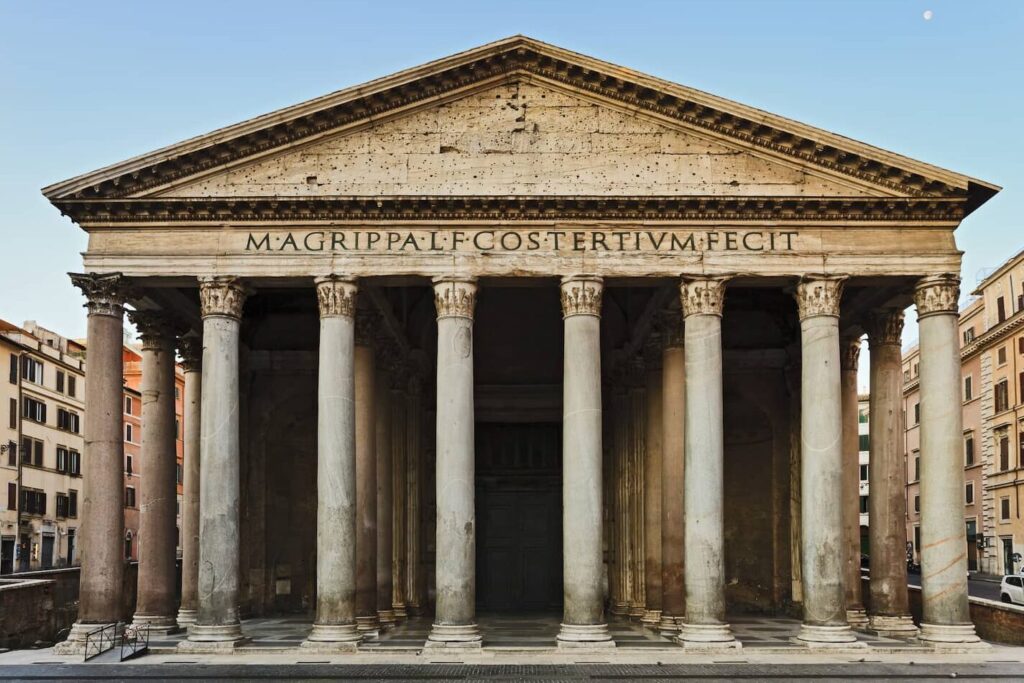
The first curiosity concerns the origin of the name, and this is a historical truth. Pantheon is the Latinization of the Greek word Pántheion Hierón, τό Πάνθειον (ἱερόν), meaning precisely Temple of all gods.
It was the historian and naturalist Pliny the Elder who created the linguistic cast that went from Latin to Italian and other languages. Just think: before he lost his life documenting the eruption of Vesuvius that buried Pompeii, Pliny made time to see the original temple of Agrippa and give us a name that has spanned the centuries.
Today the term pantheon, with a lower case, also means by extension the place where a nation’s great personalities are buried, exactly as in the case of Rome’s Pantheon, with a capital letter, where great artists and our country’s first royals rest.
The architect with the long tongue
Apolodorus was Trajan‘s favorite architect. He designed columns, harbors, markets, and forums for him. He is also said to have designed Hadrian’s Pantheon, but this is not certain.
What is certain is that Apollodorus and Hadrian, who was the adopted son of Trajan, never got along. There are anecdotes about this.
An early rift occurred while Trajan was still alive. Apoloodorus pushed Hadrian away with bad words, ” Go away, you don’t understand anything about architecture.”
The second time Hadrian was already emperor. The object of contention, the statues in the temple of Venus. To Apollodorus they were disproportionate: “They would have a hard time leaving their thrones if they wanted to stand up.”
Hadrian, who evidently had his say on those statues, did not take it well. He exiled the great architect and then had him assassinated.
The plays of light
ID 34907733 © Preisler | Dreamstime.com
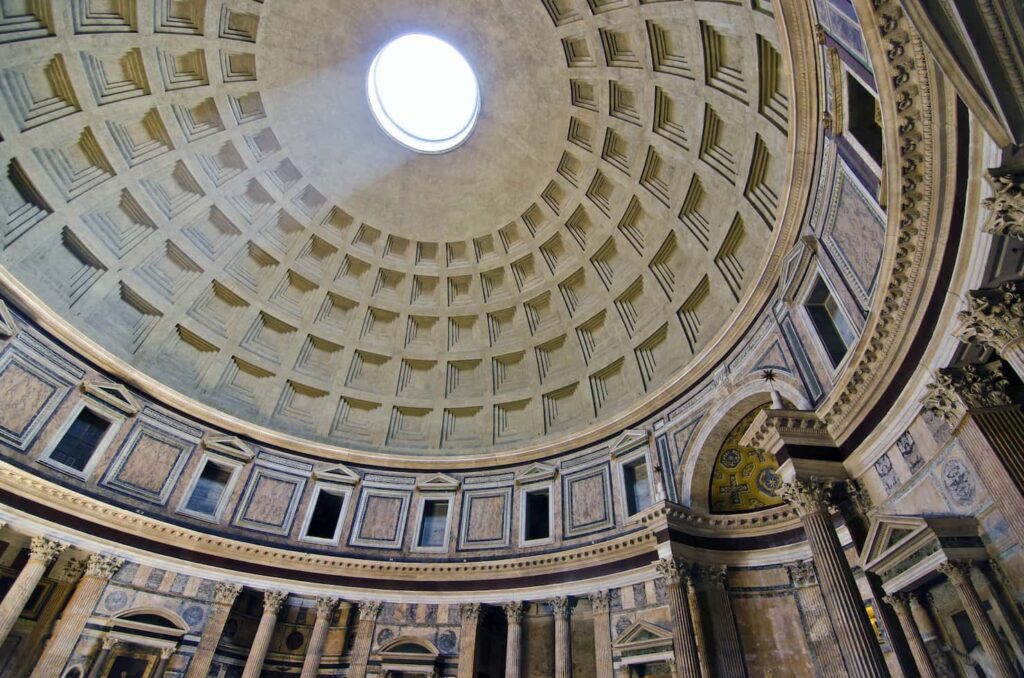
Again, this is a curiosity, since we are talking about natural phenomena occurring under the eyes of everyone, or at least of those lucky enough to be at the Pantheon at the right time.
On April 21, a ray of sunlight filtering through the Oculus goes to illuminate the Pantheon’s monumental bronze portal. Imagine the effect it must have had onEmperor Hadrian the first time he crossed the temple’s threshold on Rome’s Christmas Day.
June 21 is the day of the summer solstice. A sunbeam illuminates the floor and the entrance portal to the Rotunda amid the amazement and admiration of visitors to the Hadrianic temple.
Other days when the light of the Oculus gives rise to an impressive spectacle are recorded between April 7 and 10 and between September 2 and 6 around 1 p.m. (considering daylight saving time).
The arch above the monumental bronze entrance portal is perfectly illuminated by sunlight. A special effect that could be related to the cult of the goddess Cybele, a symbol of the generating and at the same time destructive force of nature.
Raphael’s Last Sun
ID 135852775 © Evren Kalinbacak | Dreamstime.com
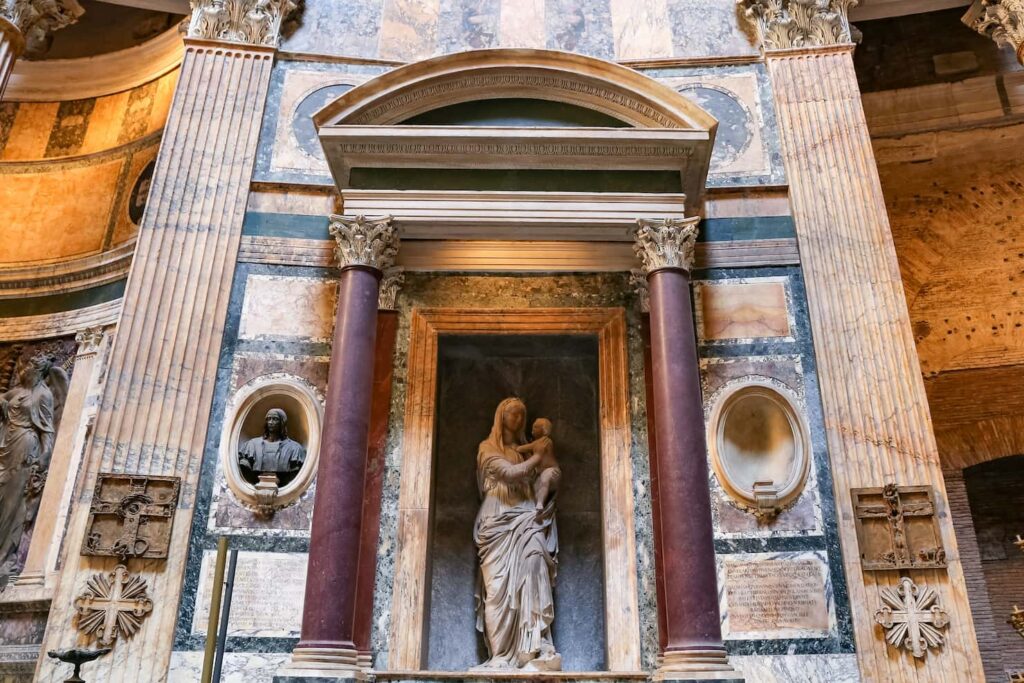
Let’s talk more about effects created by sunlight inside the Pantheon in Rome. Perhaps the most delicate and poignant one concerns the tomb of Raphael Sanzio.
Everyone knows that the painter and architect died prematurely shortly before the age of 37 and that his tomb lies at the foot of the statue of the Madonna del Sasso, sculpted by his friend and disciple Lorenzo Lotti, known as il Lorenzetto.
It is not a place chosen at random, but thought out with the precision and sensitivity that can belong only to a genius, which was precisely the Urbino-born artist.
Raphael arranged to be buried near the point where the last ray of light abounds in the Pantheon, before surrendering himself to the darkness of night.
He thinks: the sun sets. A ray caresses the tomb. Raphael can rest in the peace of the Basilica, enveloped in a darkness that a few hours later will be dispelled by the light of a new day.
The Greek poet Simonides said that painting is silent poetry and poetry painting that speaks. Who knows if Raphael was aware of this?
The flight of the demons
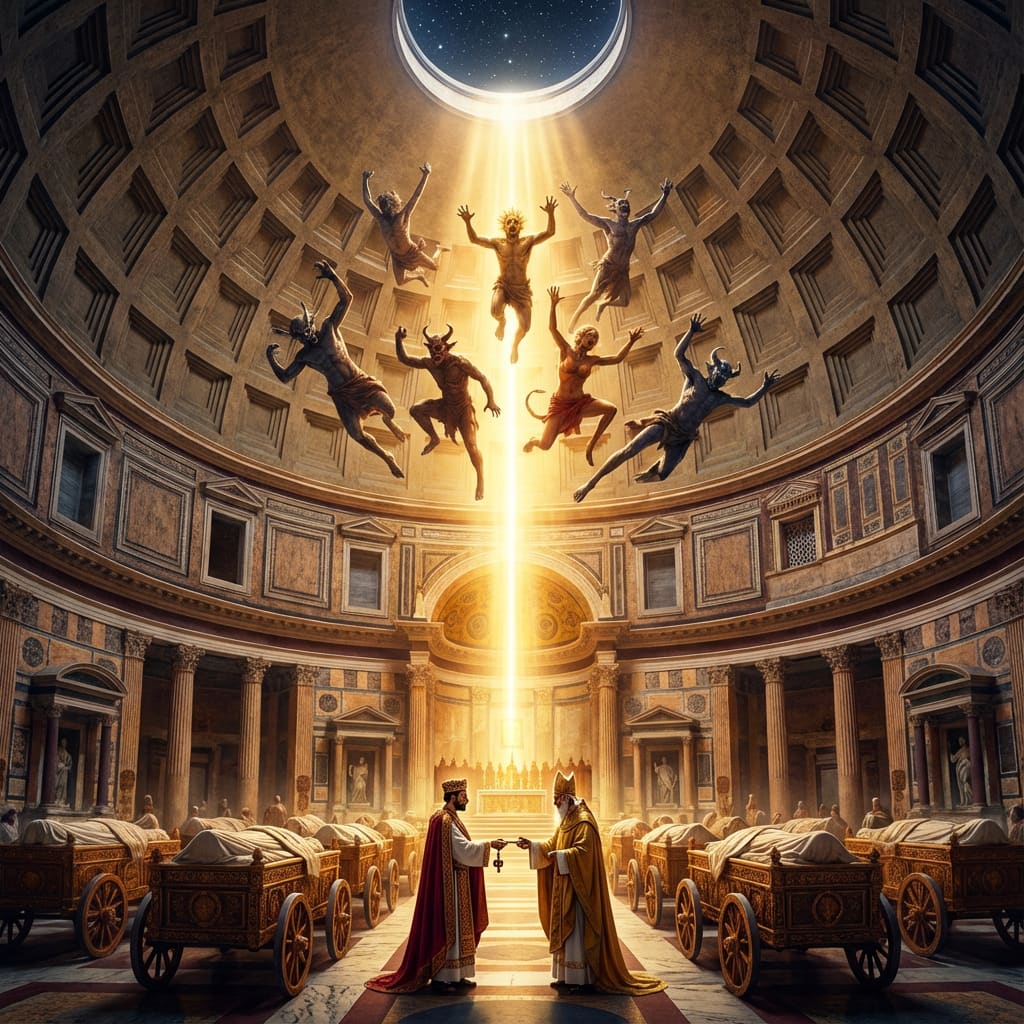
Now that’s a legend and the kind that makes an impression. The year 608 was running. The Byzantine emperor Phocas donated the Pantheon, until then a decaying pagan temple, to Pope Boniface IV.
A year later, the pontiff converted it into the Basilica of Santa Maria ad Martyres. From the catacombs arrive 18 chariots, some say 28, with the bodies of the holy Christian martyrs. The church fills with incense, the walls of the Rotunda resound with hymns and prayers. And what happens?
7 demons, like the 7 planetary deities to whom the temple was originally dedicated, at the sight of the priests flee through the Oculus. But there are also those who say that six of them took advantage of the open portal to escape and only one chose the aerial route.
The fact remains that the fleeing demon or demons blew like a cork the huge Pinecone that closed the hole in the Dome. Will this be true? The Pinecone was found in a nearby square. Will it be an accident?
The Devil’s Ditch

Peter Barlarius, also known as Bailardo, was a 12th-century magician. His life was not an example of virtue, but on reaching the age of 90 he repented of his misdeeds. His confessor revealed to him that to be forgiven he would have to hear mass on the same day in Jerusalem, Santiago de Compostela and Rome. As in, resignation.
Barlario relied on the Devil (and who else?) to give him the Book of Command and the powers to pass an impossible test. The Devil and the magician Barlario found themselves in Rome. The Devil demanded his fee, the magician’s soul.
Barlario, on the other hand, slipped him a handful of nuts and took refuge in the Pantheon, which, let us not forget, was a Christian basilica. The Devil, who did not take it well partly because of the nuts, partly because of the church where he could not enter, began to go around the building with such rage in his body that he dug a deep moat.
Around the Pantheon, on closer inspection, there is no moat. It is just that from antiquity to the present, the street level has risen several meters. But the question is, will Pietro Barlario have managed to save his soul?
The obelisk in Piazza della Rotonda
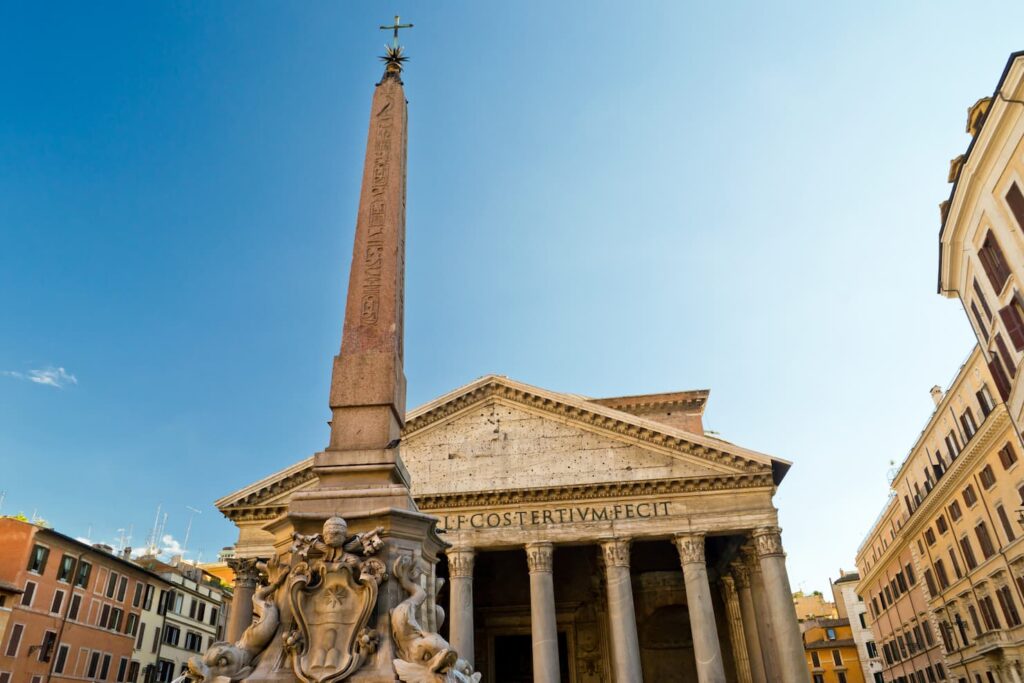
ID 27855820 | © Scaliger | Dreamstime.com
No one talks about it, but in Rotunda Square there is an obelisk. It is impossible not to notice it: it is almost 6 meters high and at its base is a fountain, with four dolphins, made by Clement XI in 1711.
It comes from Egypt and dates back to Ramses II, whose two cartouches can still be seen on the spire surmounted by a star and a cross. A work of great historical and architectural value. It is not known who and when brought it to Rome in antiquity.
The obelisk was found together with another twin under the Church of Santa Maria Sopra Minerva, built on the remains of the ancient temples of Isis and Osiris. It was moved to the Rotunda from the church of San Macuto as part of a larger project to restyle the Pantheon and Piazza della Rotonda.
Pasquino and the Barberini
Itis a curiosity, not a legend. The pope needed bronze to make cannons with which to defend Castel dell’Angelo. In those days popes were also warring kings. They found the precious material in the entablatures of the Pronao.
Urban VIII Barberini got his 80 mouthpieces, and Bernini, whom the same pope had commissioned for the Baldachin of St. Peter’s, got the bronze to make his masterpiece of Baroque art.
And the Roman people? They did not take it well and expressed their discontent through Pasquino, the talking statue that for centuries gave voice to the satirical spirit of the Eternal City.
Of course, the statue (from the Hellenistic period) did not speak. Only written messages were hung on it. Well, Pasquino ruled, “What the Barbarians did not do, the Barberini did.”
The same pontiff also commissioned, again from Bernini, the construction of two bell towers on either side of the Avancorpo. The Romans, even on that occasion did not approve: they saw them as two “donkey ears.” They would be demolished 250 years later.
Victor Emmanuel II at the Pantheon
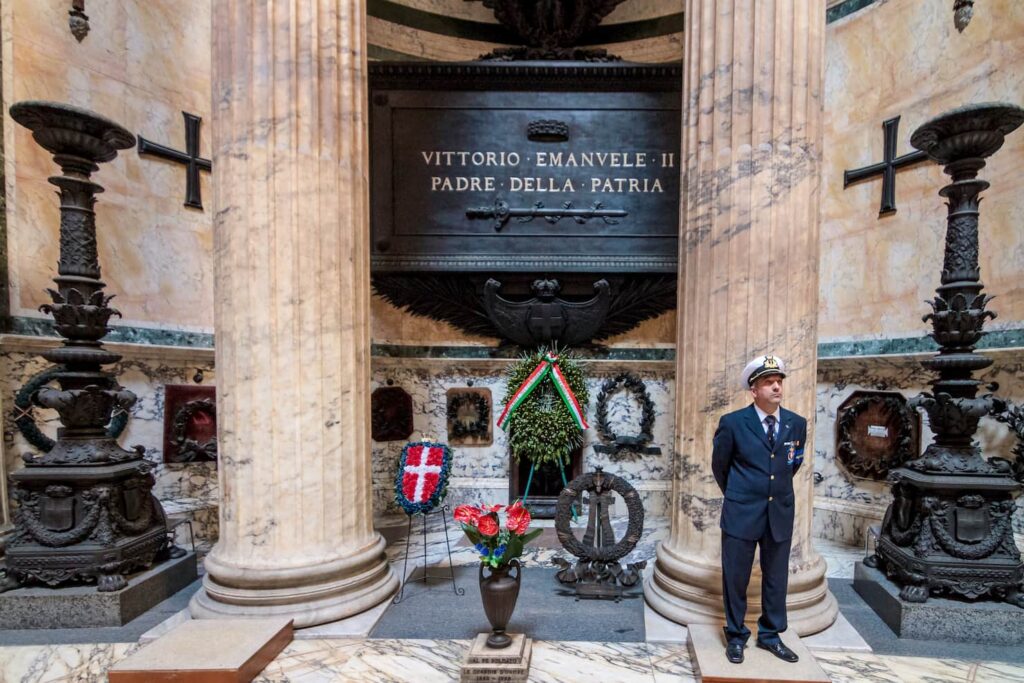
ID 39327189 © Andreas Zerndl | Dreamstime.com
This is a historical curiosity concerning Victor Emmanuel II of Savoy, the first King of Italy. The monarch died in Rome in January 1878. The royal house has its shrine at the Basilica of Superga in Turin, but there are good for change.
Burying the “Father of the Fatherland” in Rome would reconnect the ruling house with the Roman Empire-an important symbolic aspect for the Italy united just a few years before and for its new capital.
The nation needs a pantheon, and the Pantheon in Rome is the ideal solution. It is majestic, has an ultra-millennial history, and Santa Maria ad Martyres is not a papal basilica, as the heir Umberto I requires in order to consent to burial.
The Prime Minister, Agostino De Pretis, and the Minister of Internal Affairs, Francesco Crispi, put pressure on the Savoy and achieved their goal.
After the Exposition and Official Funeral, on February 16, 1878, Victor Emmanuel II has his second funeral at the Pantheon, where he has been resting ever since.
Er giro de Peppe
Victor Emmanuel II died of pneumonia in Rome on January 9, 1878. The funeral was held a week later at the Pantheon. The funeral procession took several hours before reaching the Basilica where the “Father of the Fatherland” would later be buried, due to the large crowds that had crowded along the streets and in the Piazza della Rotonda.
At one point, the story goes, Giuseppe Garibaldi arrived who, unaware of what was happening, circled the square twice, following the funeral carriage that had already belonged to Charles Albert.
So ever since, the saying has been in use in Rome, “ho fatto er giro de Peppe intorno ‘a Rotonna,appresso alla Reale,” meaning the funeral carriage. If you wander back without finding the right path or turn around in circles to get to your destination, know that you are doing “Er giro de Peppe.” You can say that even if you are not from Rome.
Last curiosity: the Hero of Two Worlds was also supposed to be housed in the Pantheon once he passed away, but he was a strongly anticlerical spirit and the Holy See opposed his burial in the Basilica of Santa Maria ad Martyres.
Rain in the Pantheon
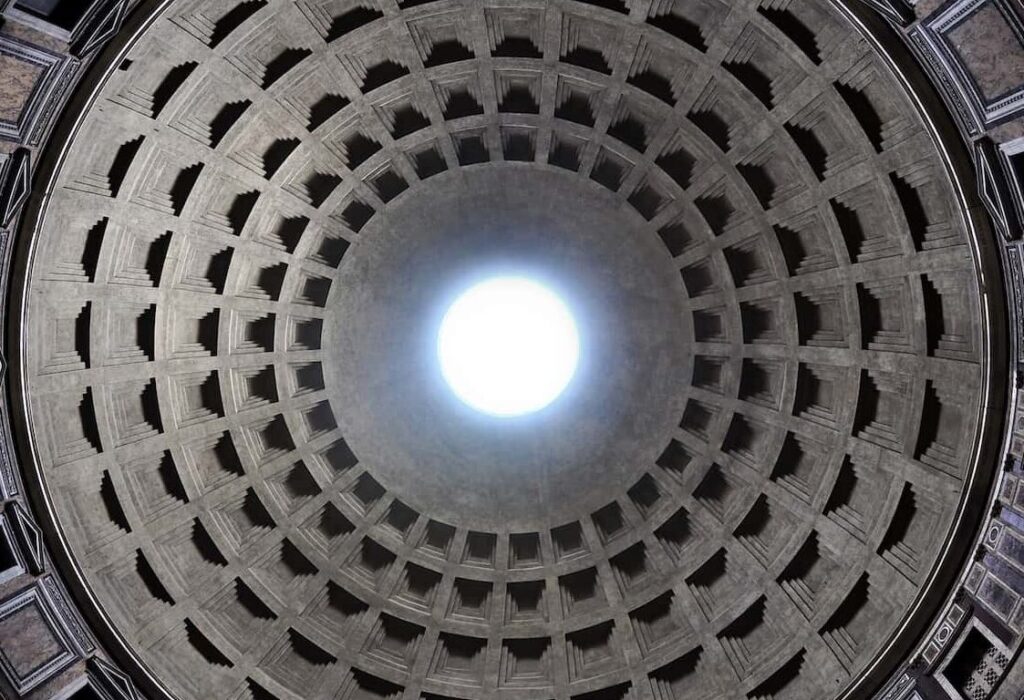
ID 9586634 | © Cenk Unver | Dreamstime.com
More than a legend, it is a false myth that of rain not entering the Pantheon. Come to think of it, it seems impossible that from the Oculus, a hole more than 9 meters in diameter at the top of the dome, no water filters in. Roman engineers, who knew a lot about hydraulics, not surprisingly built a floor with 22 drainage holes.
So how did the idea arise that it did not rain inside the Pantheon? Thanks to the smoke of the candles or rather the heat produced by them and also that of the braziers.
Rising toward the Dome, the heated air would have vaporized the drops, creating a kind of mist that would not have had time to touch the ground because it was sucked outside through the Oculus.
The image is truly evocative and poetic, but the truth is that in the Pantheon water enters. And there is no doubt about that.
The Feast of Pentecost
Speaking of rain, at the Pantheon in Rome, once a year, there is the ritual one of rose petals. It occurs on the day of Pentecost, 50 days after Easter, without a fixed date therefore.
Thousands of red rose petals are dropped through the Oculus onto the heads of the faithful gathered inside the basilica. A ceremony that goes by the name of Easter of Roses.
The descent, in the form of tongues of fire, of the Holy Spirit on the Apostles and the Virgin Mary is commemorated. The Holy Spirit gave the Apostles the power to speak any language and to carry the Word of God everywhere, confident that they would be understood.
The ceremony in the Pantheon, with visitors from all over the world, thus sees the symbolic value of that miraculous event amplified.
The Hundred of the Dome
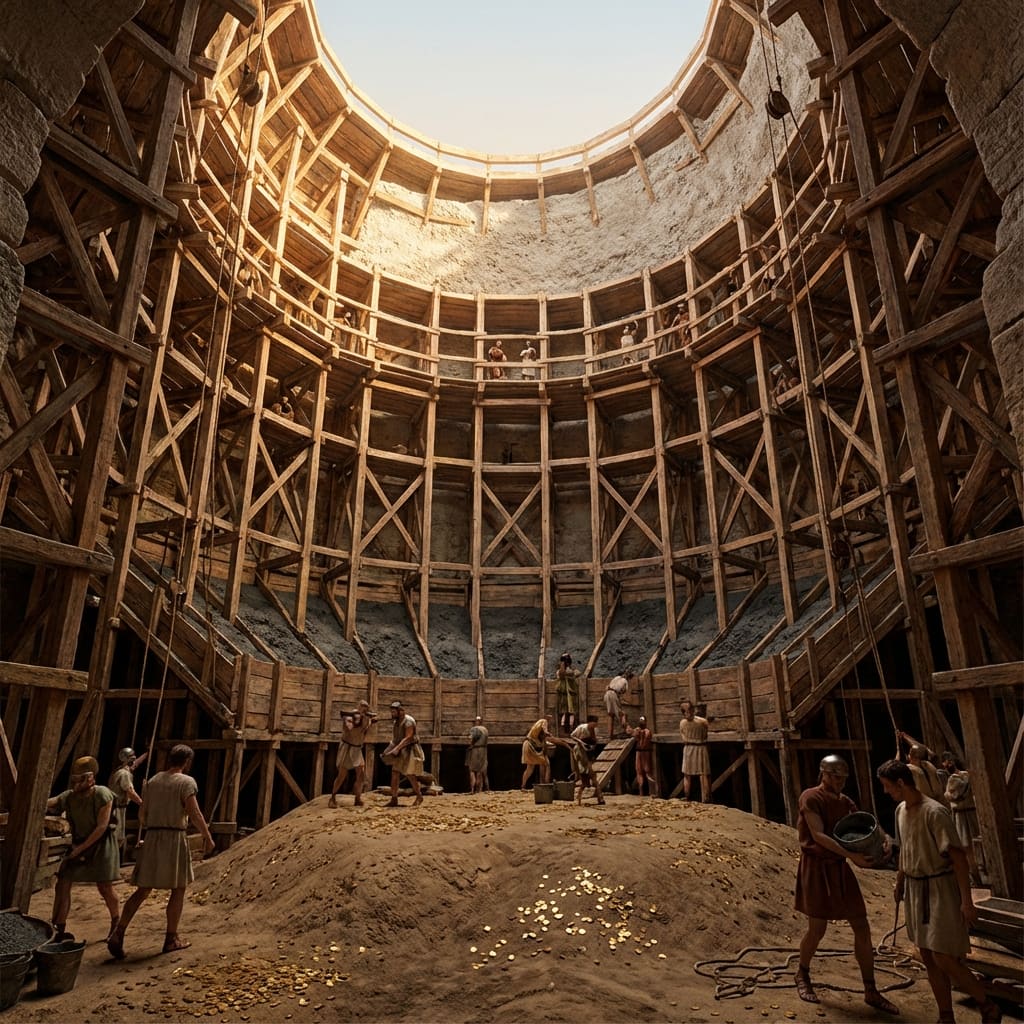
Here we are in the realm of legend. The Pantheon Dome in Rome is undoubtedly a masterpiece of architecture, symmetry and building engineering. But how was it built?
We know that a wooden centina was built, a kind of huge mold that was meant to guide the pouring of concrete, heavier at the base and lighter near the Oculus.
How did Hadrian’s engineers hold up the framework represented by the centina? It is said that we filled the Pantheon with earth, mixing in gold coins.
The disposal was paid for by the Roman people. With the hope of finding good fortune, the people rendered effective, efficient and fast service to the emperor.
The skeleton of Giuseppe Gioacchino Belli
In 1833 Giuseppe De Petris, regent of the Congregation of the Virtuous at the Pantheon, led a campaign to reconnoitre Raphael’s tomb to establish that this was his true tomb and that the remains belonged to the great Renaissance painter.
The event creates great anticipation in public opinion in Italy and around the world. When the historical truth already attested to by Vasari is confirmed, Raphael’s bones are moved to a new sarcophagus donated by Pope Gregory XVI and an epitaph is engraved on it with the words of Pietro Bembo.
Shortly after the event, dialect poet Giuseppe Gioacchino Belli, exactly on November 1, wrote a sonnet entitled “Er Corpo Aritrovato.” He describes the media uproar, the ferment and anticipation of the people for the response of an investigation that held everyone in suspense.
In Belli’s verses, the Rotunda is full of people. Everyone, as in an endless chant, wonders whether it is Raphael’s bones or not. The closing of the sonnet is the manifesto of Roman sarcasm: “Do you find a jest in de la terra smossa? Ebbè, senza de fa ttanti misteri, Aributtelo drentro in de la fossa.”
If you find a skeleton, without making too much fuss, put it back where it was.
Phrases about the Pantheon
The oldest phrase about the Pantheon can be read on the pediment of the temple, “Marcus Agrippa, son of Lucius, consul for the third time, built it.” Marie-Henri Beyle, known by the pseudonym Stendhal, considered the Pantheon“the most beautiful remnant of Roman antiquity.”
And Goethe wrote, “Here the grandeur of the Rotunda, both outside and inside, aroused in me a joyous sense of reverence.”
Michelangelo Buonarroti, who studied the Pantheon extensively for the dome of St. Peter’s, called it “the work of angels and not of men.” A contemporary architect, Spaniard Alberto Campo Baeza, remarked, “If I were asked for advice on how to destroy architecture, I would suggest closing the ring of the Pantheon.”
The most pregnant phrase, however, is found in the common speech of Romans. “Dimme er Pantheon, non a Rotonna,” meaning, “Tell me the Pantheon, not the Rotunda.“
It is a direct invitation to be clear. The Pantheon is one thing, the square where it stands is another. And they are right. Perhaps they would also say this to Emperor Hadrian, who kept the dedication to Agrippa, who built the Augustan temple, not his own. One has to be precise.
FAQ
A variety of legends exist about the Pantheon. The best known are those of the ditch dug by the Devil; the flight of demons through the Oculus; and Peppe’s tour following the coffin of Victor Emmanuel II.
The 7 deities of the Pantheon are the 7 planets visible to the naked eye: the Sun, Moon, Jupiter, Saturn, Mars, Venus and Mercury. They are the same ones to whom the Augustan temple erected by Agrippa was dedicated.
It is the legend of a magician who sold his soul to the devil in exchange for a book with special powers. The magician does not pay the fee due and takes refuge in the church. The devil enraged that he cannot enter, begins to go around it digging the moat still visible today.
Legend has it that the heat from the candles and brazier flames created a hot current that vaporized the water droplets drawn outside by the Oculus chimney effect. The truth is that it rains in the Pantheon, all right.
Conclusions
We have come to the end of this article devoted to the curiosities, legends, and quotations that have arisen around this incredible monument that arouses the admiration of us all.
Between myth and reality, we have traversed almost 2,000 years of history, immersing ourselves in thesoul of the Pantheon, discovering why this place has always been an integral part of the life and imagination of the Eternal City .
Our hope is that these tales have enthralled you enough to give you one more reason to visit the Pantheon live, beginning your journey of exploration right now by booking now and purchasing your ticket online.
Would that you knew how much more there is to know.
Bestseller ever
Pantheon of Rome: Quick Access Ticket + Official Audio Guide
Quick access and audio guide included: discover the history of the Pantheon and admire the famous dome and oculus.
Secure payment
Instant confirmation
Mobile ticket
