
Are you planning to visit Rome and want to know what are the best attractions near the Pantheon?
You should know that there are at least 21 wonders to visit in the vicinity of the Pantheon in Rome: I’m talking about St. Peter’s, Castel Sant’Angelo, the Colosseum, the Roman Forum, Piazza Navona, the Basilica of San Luigi dei Francesi the Trevi Fountain, and many more.
This article will offer you valuable suggestions to enrich your stay in Rome by exploring some of the most important and famous cultural sites in the Eternal City.
The great beauty of Rome almost seems to revolve around Hadrian’sPantheon.
And it’s all within a few minutes’ walk.
Yes, it’s just a starting point, but you have to start somewhere.
Legs on your shoulders, then!

Bestseller ever
Pantheon of Rome: Quick Access Ticket + Official Audio Guide
Quick access and audio guide included: discover the history of the Pantheon and admire the famous dome and oculus.
Secure payment
Instant confirmation
Mobile ticket
- 1 What to see near the Pantheon in Rome
- 1.1 Navona Square
- 1.2 San Luigi dei Francesi
- 1.3 Trevi Fountain
- 1.4 Colosseum
- 1.5 Imperial Forums
- 1.6 Rotunda Square
- 1.7 Spanish Steps
- 1.8 Campo de’ Fiori
- 1.9 Castel Sant’Angelo
- 1.10 Saint Peter’s Basilica
- 1.11 Vatican Museums
- 1.12 Sistine Chapel
- 1.13 The Pantheon and the Pigna District
- 1.14 Largo di Torre Argentina
- 1.15 Basilica of Santa Maria Sopra Minerva
- 1.16 Doria Pamphilj Gallery
- 1.17 Venice Square
- 1.18 The Vittoriano
- 1.19 Venice Palace
- 1.20 Church of St. Ignatius of Loyola
- 1.21 Church of Jesus
- 2 Map with attractions near the Pantheon
- 3 FAQ about attractions near the Pantheon in Rome
- 4 Conclusions
What to see near the Pantheon in Rome
Rome is one of the richest cities in the world in terms of art, history and culture, but it also has a special feature: seeing some of its most admired treasures concentrated in a small radius.
Thus, starting from Pantheon you can reach … everything.
Follow us on this itinerary to discover the wonders of Rome.
Come on, let’s go!
ID 32681345 | © Phant | Dreamstime.com
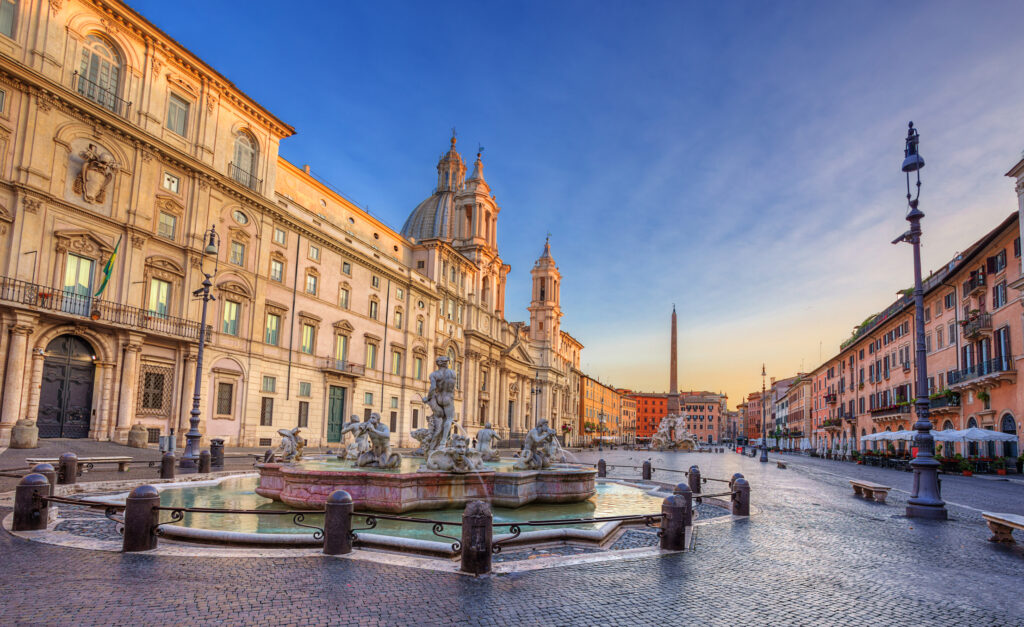
A five-minute walk. This is the distance that separates the Pantheon from one of Rome’s Baroque masterpieces: Piazza Navona.
In what in Roman imperial times was the Domitian Stadium, later Circus Agonales, you can see today the Fountains of the Moor and the Fountain of Neptune.
And, of course, what is the most famous work: the Fountain of the 4 Rivers (Nile, Ganges, Danube and Rio de la Plata), by Gian Lorenzo Bernini. Towering over it is theAgonal Obelisk, transported here from the Circus of Maxentius, from theAppian Way, where it lay abandoned.
Also insisting on Piazza Navona is the church of Sant’Agnese in Agone, designed by Francesco Borromini, Bernini’s great rival for winning contracts concerning the restyling of the area during the 17th century.
Piazza Navona, whose name derives from the competitive games held here in Roman times, has maintained its natureas a lively and popular place over the centuries.
It has been a sports stadium, a market square, and a seasonal “pool” when it was flooded to give refreshment to the people during the torrid Roman summers. Today, street performers and tourists meet there, making the atmosphere sparkling both during the day and in the evening.
San Luigi dei Francesi
ID 70883975 © Benkrut | Dreamstime.com
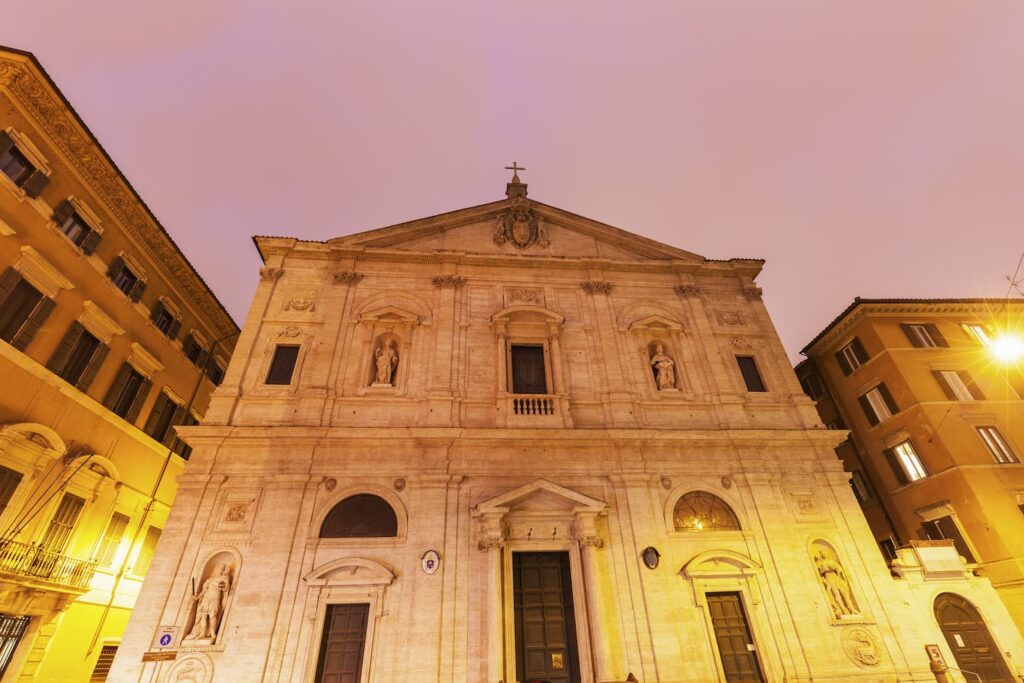
A short walk from Piazza Navona, then, a 5-minute walk from the Pantheon, you will find the Church of San Luigi dei Francesi.
If your passion is the painting of Michelangelo Merisi, known as Caravaggio, this place of worship gives you 3 of his absolute masterpieces: “The Vocation of St. Matthew,” “The Inspiration,” and “The Martyrdom of St. Matthew.” You can admire them in the left aisle in the Contarelli Chapel.
The French National Church was begun in 1518 and completed in 1589 by architect Giacomo Della Porta. Inside it holds statues of Charlemagne and Louis IX, canonized in 1297 by Pope Boniface VIII.
The right aisle of the church is dedicated to Saint Cecilia, and here you can admireDomenichino’s fresco illustrating stories of the saint and the altarpiece, an admirable work by Guido Reni. On your way out, don’t forget to look up at Joseph Merkin’s splendid organ, dated 1881
Trevi Fountain
ID 45131268 | © Tomas1111 | Dreamstime.com
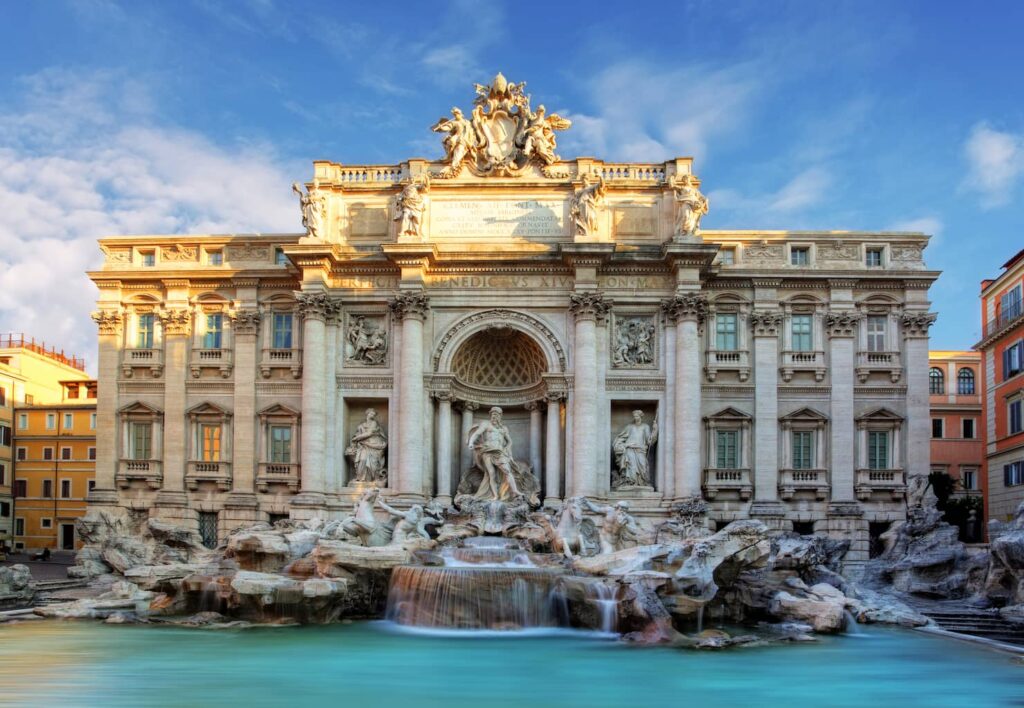
It takes no more than 7 to 8 minutes to cover the 650 meters that separate the Pantheon from another, famous wonder of Rome: the Trevi Fountain.
A symbol of Federico Fellini’s “La Dolce Vita “thanks to the unforgettable scene with Anita Ekberg and Marcello Mastroianni, the Trevi Fountain is yet another baroque masterpiece of the capital.
It dates back to 1762 and has a historical connection with Rome’s Pantheon because it is the terminal point of theAqua Virgo aqueduct, built by Marcus Vipsanius Agrippa himself, the designer of the original temple.
The theme of the fountain, designed by Nicola Salvi and completed by Giuseppe Pannini, is the sea. In fact, the scene is dominated by the statues of Ocean standing on a shell-shaped chariot drawn by the horses Agitato and Placido, like the moods of the sea.
Behind them, inside two side niches, are the statues of Abundance and Salubrity and above them bas-reliefs depicting Agrippa and the Roman virgin who led the soldiers to discover the spring from which to capture the water.
You can’t miss it. And don’t forget to toss a coin into the pool.
Colosseum
ID 15338615 © Viorel Dudau | Dreamstime.com
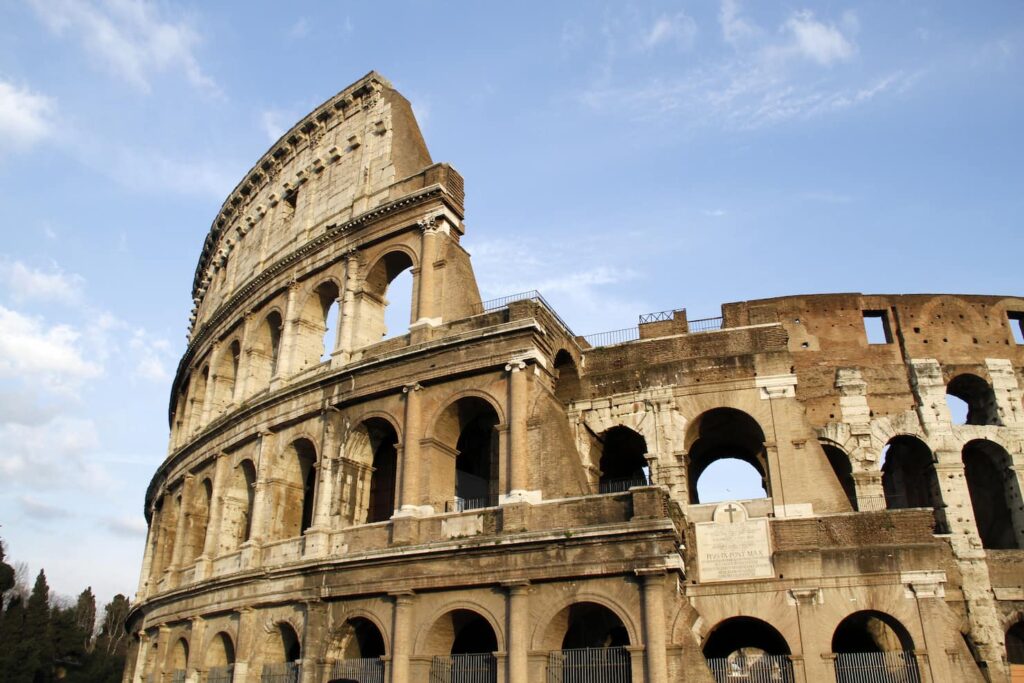
It won’t be a 2 kilometer walk that will scare you! A half-hour walk and from the Pantheon you’ll get to the Colosseum.
Vespasian began work on its construction in 70 AD, but Titus inaugurated it in 80 AD.
A giant statue of Nero erected nearby ended up in time turning the original name, Flavian Amphitheater, into Colossus of Nero, and then into Colosseum, by which it is known in every corner of the Planet.
It could hold up to 80000 spectators. It hosted gladiatorial fights and naval battles, fierce animal hunts, and public executions.
It is said that over 50000 people worked at its construction site, including architects and engineers, masons, low laborers and slaves.
It was to be the symbol of the power of the Roman Empire. It was and today it is the symbol of Rome in the world, the monument that every tourist visiting the Eternal City wants to and must visit.
Speaking of eternity a saying states that Rome will not fall as long as the Colosseum stands. In the meantime, you don’t waste time and buy your ticket online now and here.
Imperial Forums
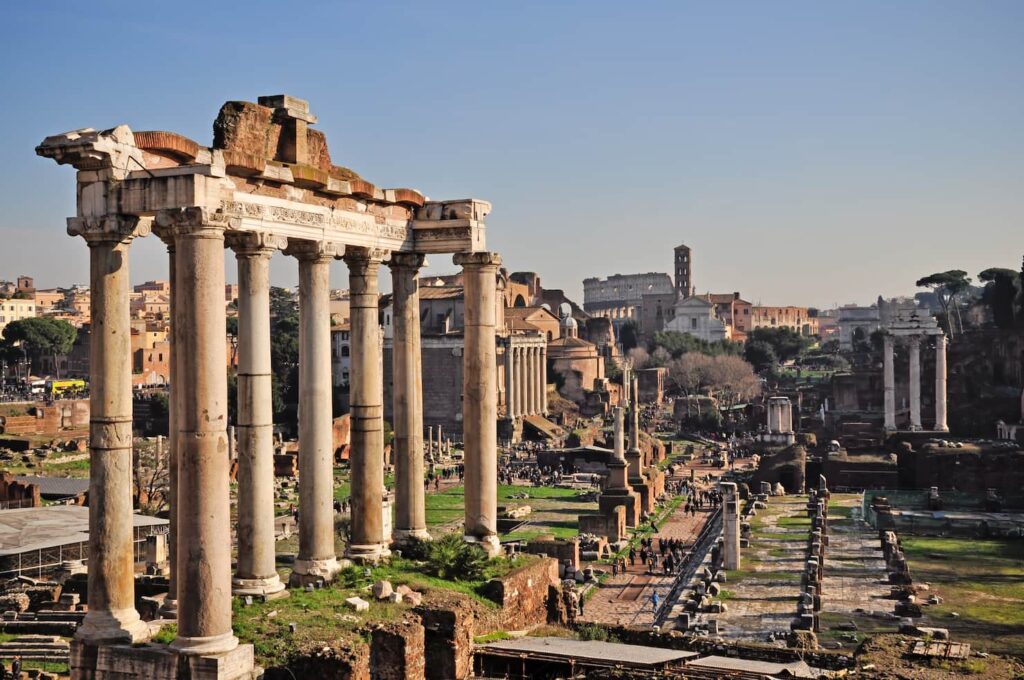
ID 17739089 | Of © Zilli Roberto | Dreamstime.com
Rome’s Pantheon is about 1.5 kilometers from the Imperial Forums, the set of five monumental squares that arose between 46 BC and 113 AD.
They were built by Julius Caesar and the emperors Augustus, Vespasian, Nerva and Trajan, under whom Rome reached its greatest territorial expansion.
Acelebration of the political and military triumphs of Rome in the first two centuries of the Christian era, the Imperial Forums are of extraordinary archaeological significance.
The area they cover stretches from the Quirinal Hill to the Roman Forum, the beating heart of the Urbe’s political and religious activity from theage of kings, expanded in the Republican era.
The spaces consisted of squares, basilicas, buildings dedicated to the administration of the state, places of worship, markets, and columns.
Of the 5 Imperial Forums, the most impressive is Trajan’s, with the very famous column celebrating the conquest of Dacia (present-day Romania).
Rotunda Square
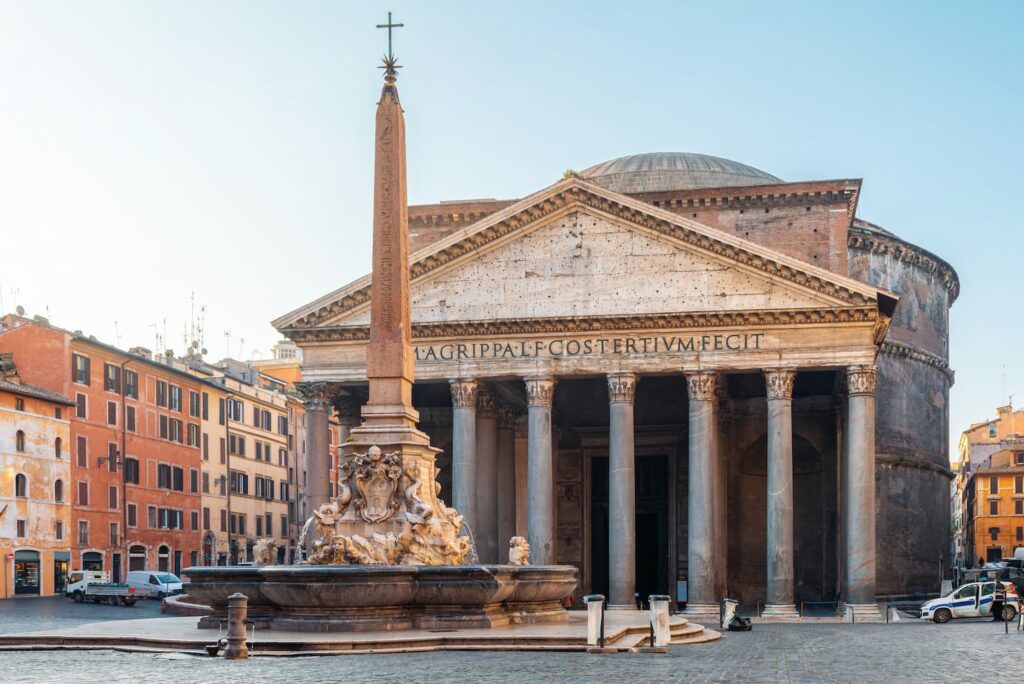
ID 54834157 | Of © Gordon Bell | Dreamstime.com
Itstands just across the street from the Pantheon and is named after the monument, so called by the Roman people since the Middle Ages.
It deserves your attention for its great historical importance, since this is the place in the Campus Martius that witnessed the assumption into heaven of Romulus, founder of the Urbe.
In the area, Marcus Vipsanius Agrippa built not only the original Pantheon, but also the city’s first baths, the Temple of Neptune, to celebrate the victory in the naval battle of Actium, and the Saepta Iulia, a monumental complex in honor of the gens to which Julius Caesar and Octavian belonged.
In the center of the Piazza is theMacutean Obelisk towering above the fountain designed by Giacomo Della Porta. Pay attention to it before or after visiting the Pantheon.
Spanish Steps
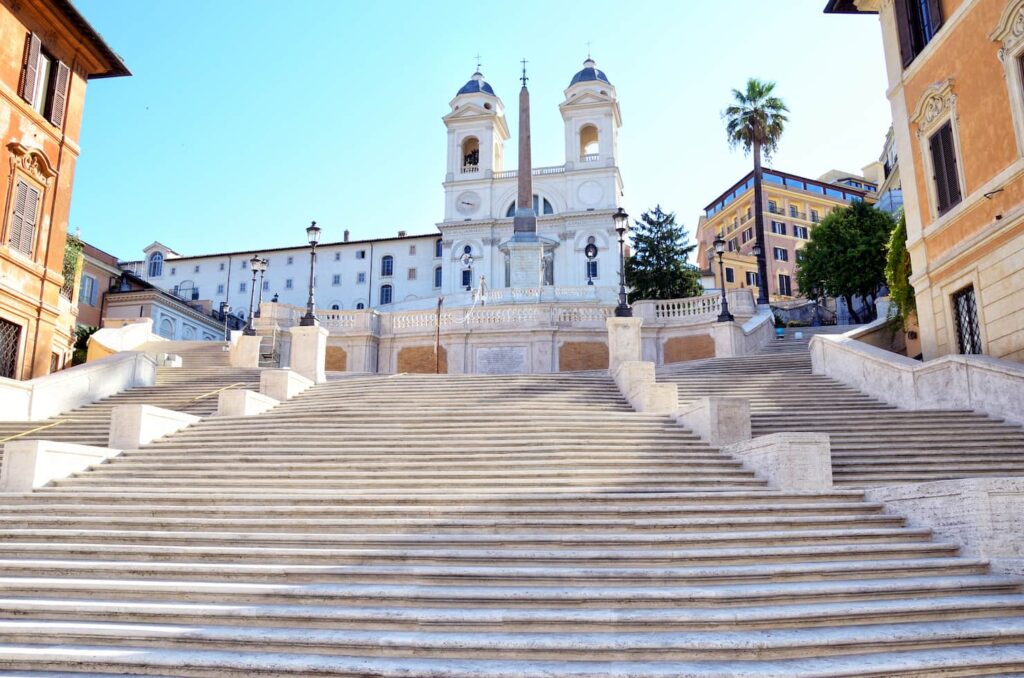
ID 77089470 © Dezign80 | Dreamstime.com
A little more than 1 kilometer from the Pantheon, walking down the luxurious Via dei Condotti, one arrives at the Spanish Steps.
The place-name derives from the presence of theSpanish Embassy to the Holy See since 1622, but what makes it famous is the stairway up to the Trinità dei Monti church, from which the square reveals its distinctive butterfly-wing design.
Another iconic element is the Fountain of the Barcaccia, a masterpiece by Pietro Bernini and his son, Gian Lorenzo.
Near the Palazzo della Propaganda Fide is the Column of the Immaculate Conception, which has protected the square since 1857.
Campo de’ Fiori
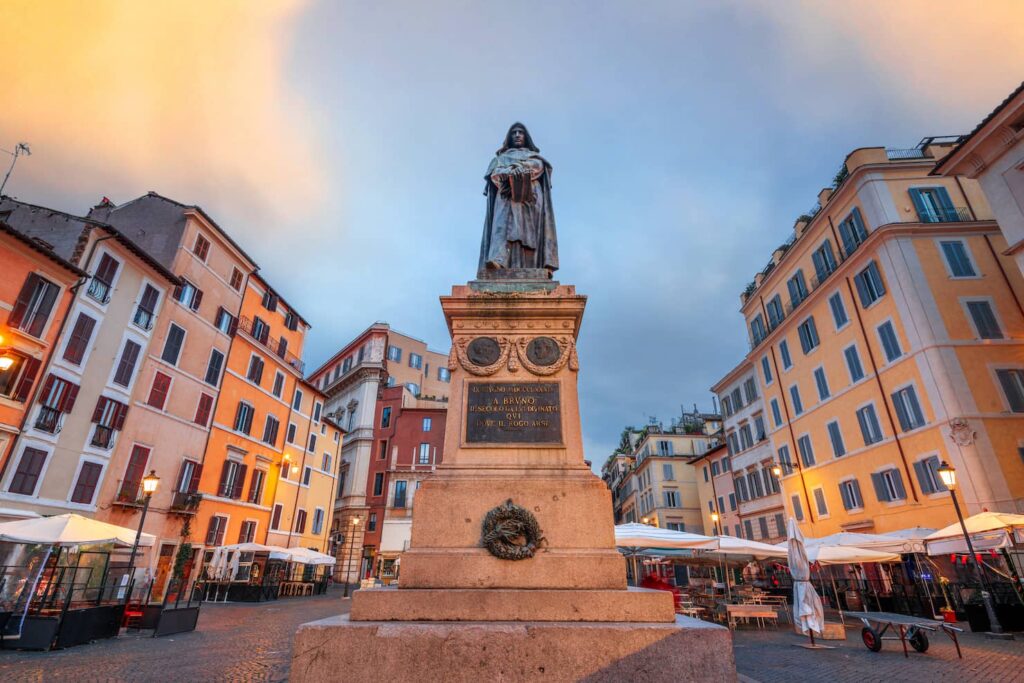
ID 255735750 © Sean Pavone | Dreamstime.com
Campo de’ Fiori is located just under 1 kilometer from the Pantheon. It is perhaps due to a Pompey mistress named Flora that the square, which did not exist until the 15th century, was named. In its place were a meadow and cultivated vegetable gardens, and this is themost likely origin of the place name.
For centuries, executions of death sentences took place here. A 19th-century statue by sculptor Ettore Ferrari commemorates that of Giordano Bruno, the philosopher burned alive on charges of heresy in 1600.
The special feature of Campo de’ Fiori? It is theonly square in Rome not overlooked by a church.
It hosts a lively market, is full of places frequented by young people, and has a beautiful atmosphere. A place not to be missed.
Castel Sant’Angelo
ID 47758018 © Emicristea | Dreamstime.com
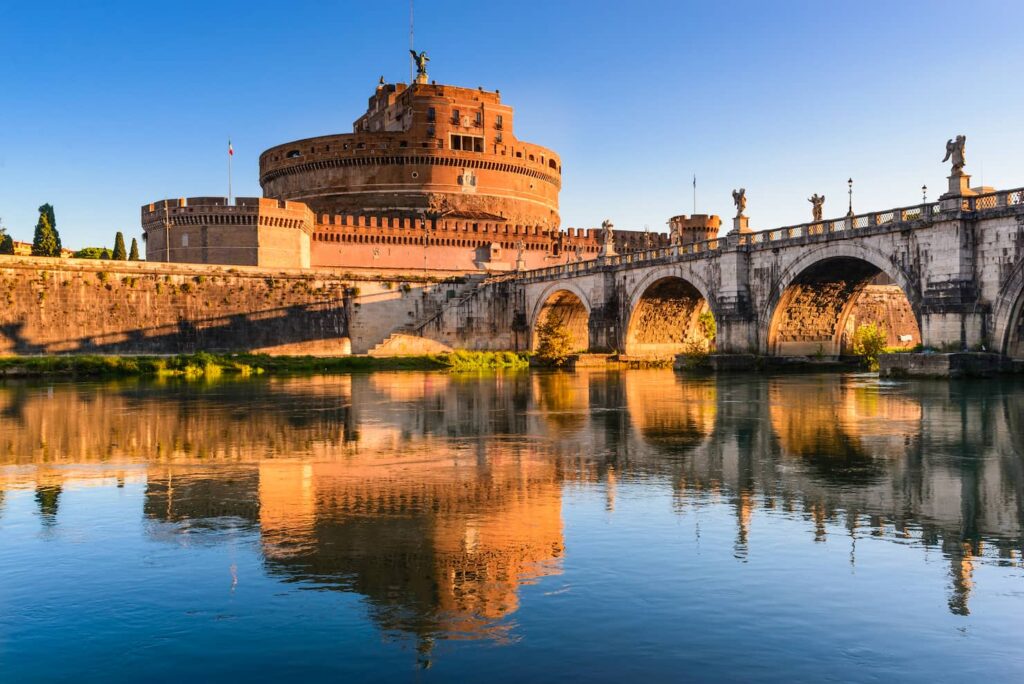
It takes a little more than a quarter of an hour to walk to the Castel Sant’Angelo, located on the right bank of the Tiber, within walking distance of the Helios Bridge and the Vatican. This monument, dating back to the second century AD, also connects in some way to the Pantheon.
It was erected as the funeral mausoleum of Emperor Hadrian, who also commissioned the reconstruction of the Temple of All Gods, and housed the remains of his wife Vibia Sabina, and several emperors, including Commodus, Marcus Aurelius, and Caracalla.
The name is linked to the appearance ofArchangel Michael who announced the end of a deadly plague in 509. A church was built on top of the Mole Adrianea, while in the 12th century a statue of the Angel in the act of sheathing his sword was erected.
The history of Castel Sant’Angelo is so long and interesting that a book would not be enough to tell it. Start visiting it to learn more.
Saint Peter’s Basilica
ID 3709969 © Miroslav Hasch | Dreamstime.com
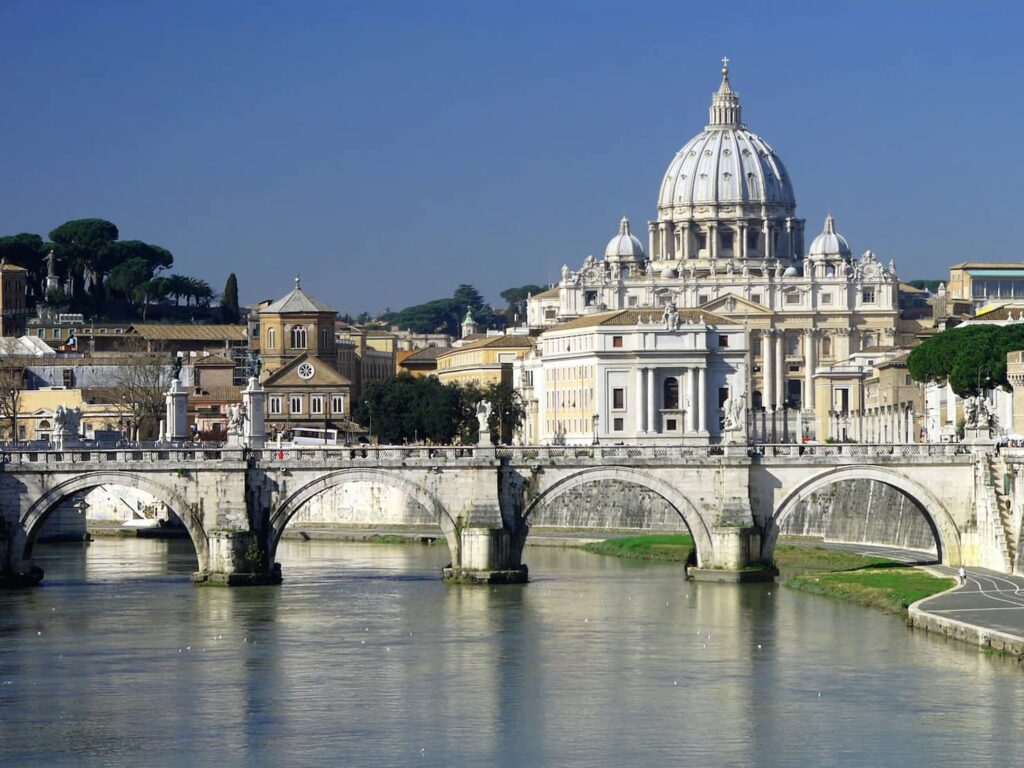
St. Peter’s Basilica, a 30-minute walk from the Pantheon, begins to amaze you already from the square and its colonnade, a 17th-century masterpiece created between 1656 and 1667 by Gian Lorenzo Bernini.
The ellipse to which the 284 columns arranged in 4 rows give shape symbolizes the arms of the Church. The colonnade is enriched by 140 statues of saints, an obelisk and two fountains.
Talking about the present Basilica would take a long time, if only to mention the architects who succeeded the project initiated in 1506 by Pope Julius II.
Let us limit ourselves to saying that the facade, characterized by thegiant order envisioned by Michelangelo, is the work of Carlo Maderno, who renounced the marked pronaos that the Tuscan master had conceived.
The dome, at 42 meters in diameter and 130 meters high, is one of the largest in the world ever built in masonry. Michelangelo, who designed it following the ideas of Bramante and Raphael, did not live to see it finished in 1590.
Inside the Basilica, by size one of the largest Christian churches in the world, a couple of iconic works of art history await you: the 1499 Vatican Pieta, sculpted by a Michelangelo just 24 years old, and Bernini’s Baldacchino (1634), famous for its gilded bronze twisted columns.
Best Selling Ever
Pantheon of Rome: Quick Access Ticket + Official Audio Guide
Quick access and audio guide included: discover the history of the Pantheon and admire the famous dome and oculus.
Secure payment
Instant confirmation
Mobile ticket
Vatican Museums
ID 268193764 | © Radek Sklenicka | Dreamstime.com
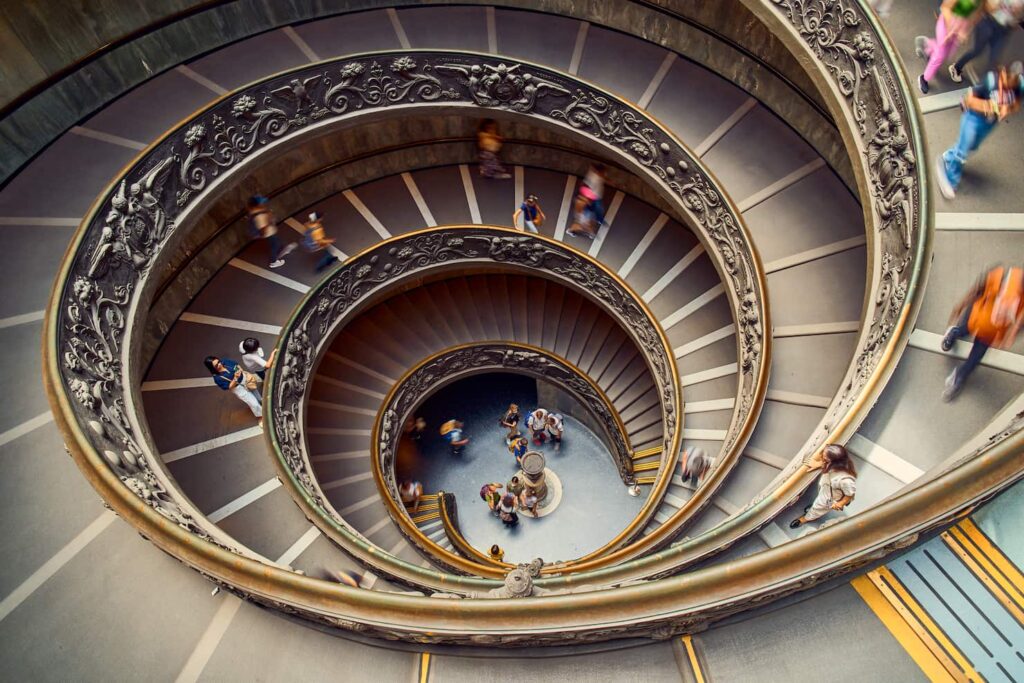
A 30-minute walk from the Pantheon, you’ll find the Vatican Museums, one of the richest and most prestigious art collections in the world-a cultural institution founded in 1506 by Pope Julius II.
Among the works not to be missed are the frescoes of Raphael’s Stanze and in particular the Stanza della Segnatura with the famous School of Athens.
Not to be missed are the Gallery of Maps; the Pinacoteca with works by Raphael himself , Leonardo, Giotto, Perugino, Caravaggio; the spiral staircase; and the marble Laoconte group.
Sistine Chapel
ID 123042521 | Of © Mistervlad | Dreamstime.com
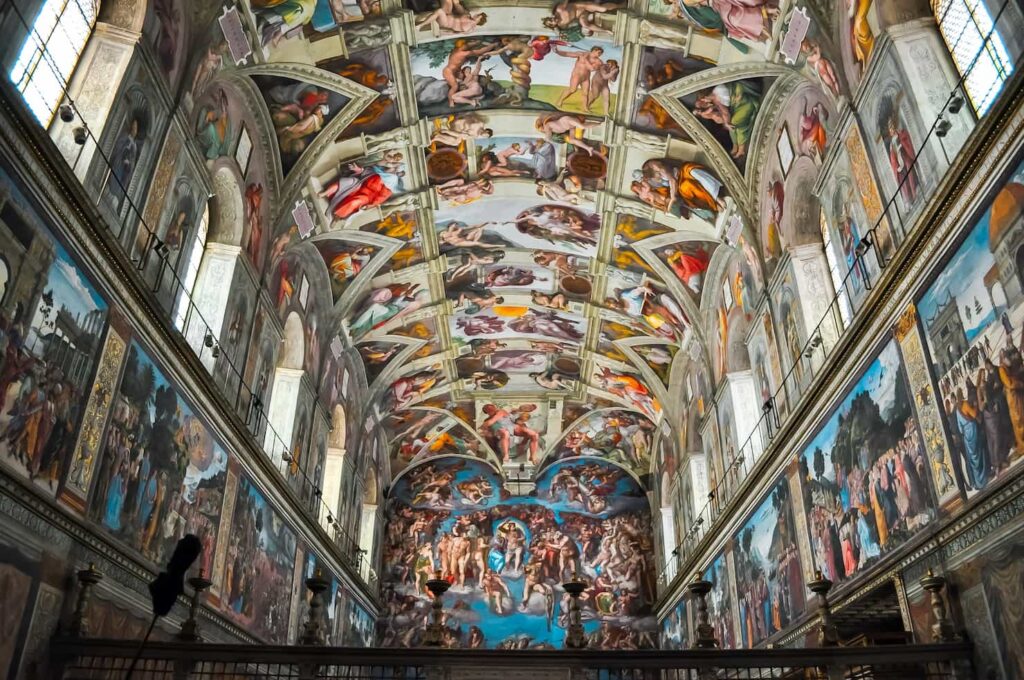
Included in the itinerary of the Vatican Museums, the Sistine Chapel, is dedicated to St. Mary Assumed into Heaven and is where the conclave for the election of the pontiff is held.
Commissioned by Pope Sixtus IV, from whom it takes its name, the Sistine Chapel is world famous for the frescoes on the vault and back wall, created by Michelangelo Buonarroti.
The earliest date from 1508-1512, while the Last Judgment was completed in 1541.
The Chapel’s other walls feature 15th-century works by Botticelli, Pinturicchio, Perugino, and Domenico Ghirlandaio.
The Pantheon and the Pigna District
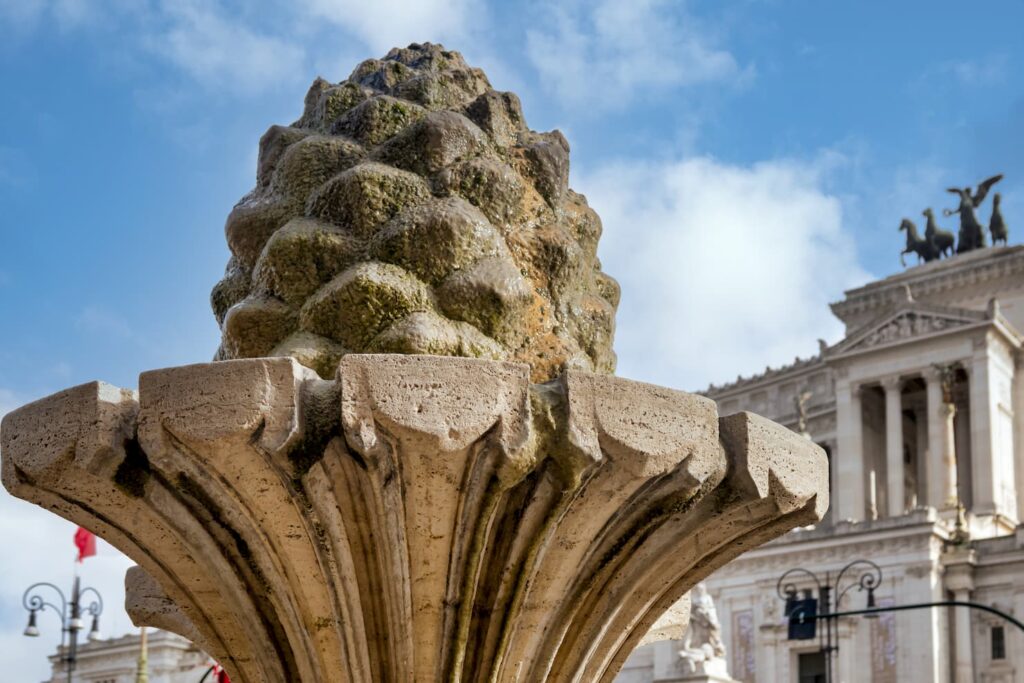
ID 300410075 | © Onlyfabrizio | Dreamstime.com
The Pantheon of Rome is located in the Rione Pigna (R IX) in the heart of Rome’s historic center, a World Heritage Site.
In this area, whose urban and street layout has remained unchanged since theRenaissance period, there are a number of sites of great cultural interest. You can discover them with us and immerse yourself in the history of a neighborhood all to experience.
Are you ready?
Largo di Torre Argentina
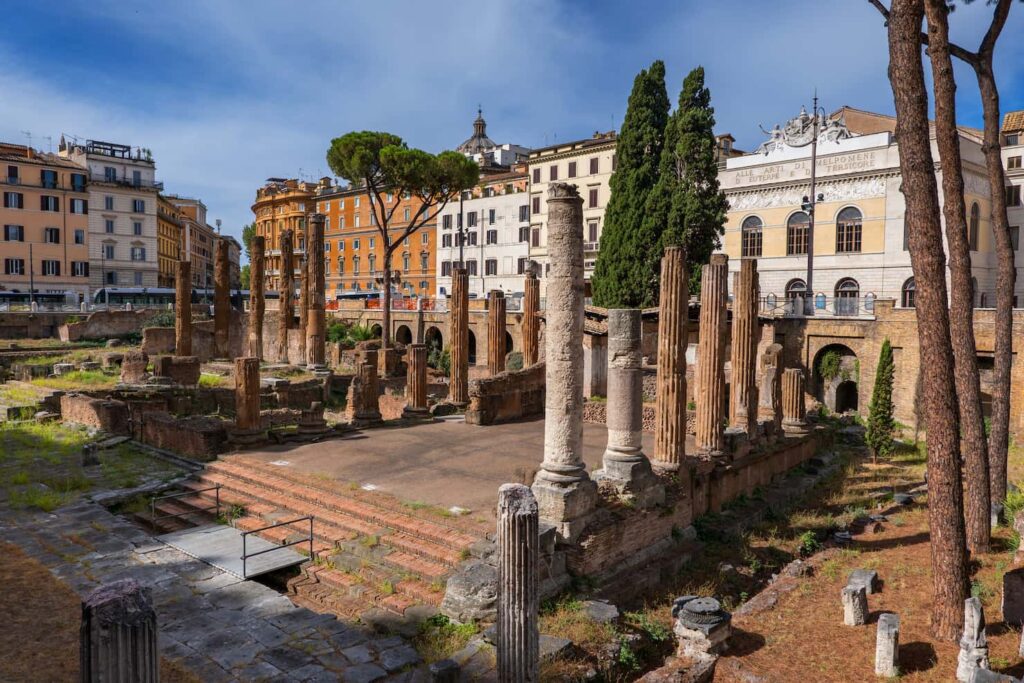
ID 203447368 | Of © Artur Bogacki | Dreamstime.com
If you love Roman vestiges, a short distance from the Pantheon you can visit the archaeological area of Largo di Torre Argentina, named after Bishop Johannes Burckardt, a native of Strasbourg whose Latin name was Argentoratum.
The sacred area is located in the center of a square created between 1926 and 1929 by thinning medieval buildings. The Roman remains are from the Republican period dated from the 4th B.C. onward, and would belong to temples whose titling is uncertain.
It is said that in these parts, where Pompey’s Theater stood, the assassination of Julius Caesar took place in 44 BC. Today, Largo di Torre Argentina is also famous for its colony of stray cats.
Basilica of Santa Maria Sopra Minerva
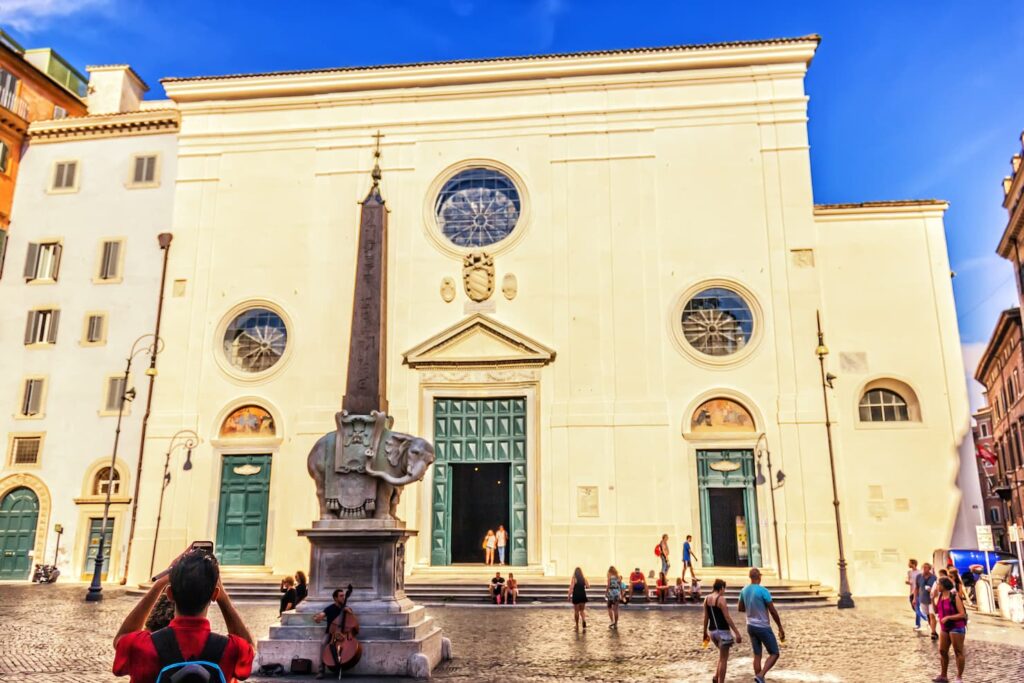
ID 129575675 | © Anton Aleksenko | Dreamstime.com
Also a short distance from the Pantheon is the Basilica of Santa Maria sopra a Minerva, where in ancient times stood the temples of Isis and Osiris and where the Egyptian obelisk that today surmounts an elephant designed by Bernini comes from.
The facade is in the Abruzzese Romanesque style. The interior, one of the rare examples of Gothic in Rome, has frescoes by Melozzo da Forli and Filippino Lippi, as well as funerary works attributed to Michelangelo and Bernini.
The Basilica also houses the tombs of St. Catherine of Siena, co-patron saint of Rome, Italy and Europe; Blessed Angelico, universal patron saint of artists; Pietro Bembo; and numerous popes.
Doria Pamphilj Gallery
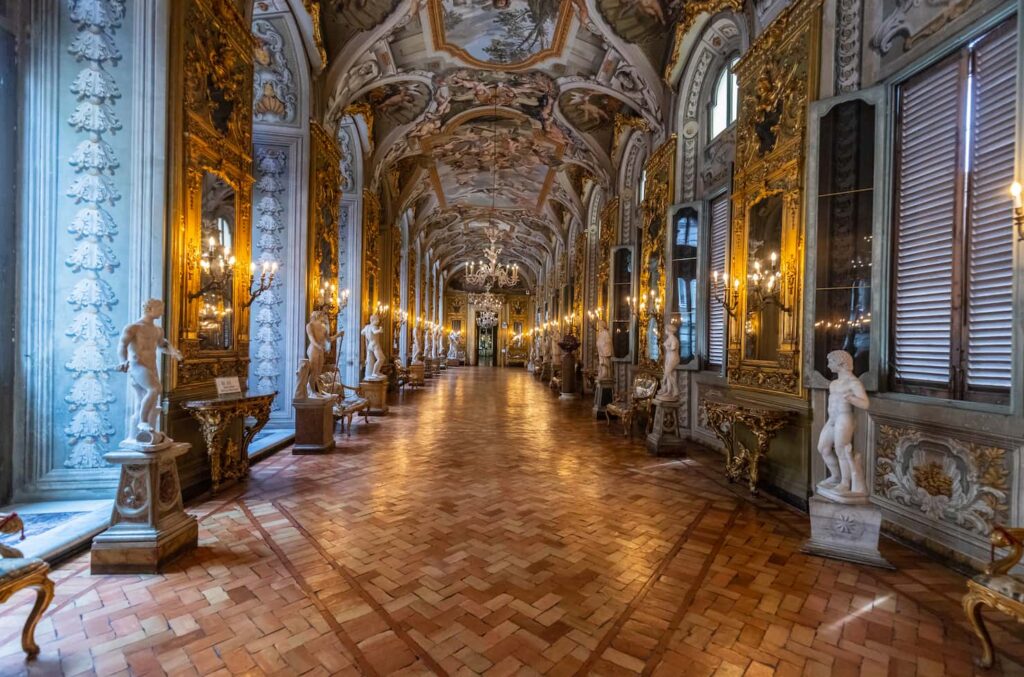
ID 313602596 © Yury Morozov | Dreamstime.com
Another destination not to be missed is the Doria Pamphilj Gallery, commissioned by Pope Innocent X in 1651, perhaps the largest private collection in the capital with its 400 masterpieces preserved inside.
It is located in the palace of the same name on Via del Corso still used as a private residence. The original core dates back to the 14th century, completion to the 18th century, and the architectural style is Rococo Baroque.
Notable works include the portrait of Innocent X, painted by Diego Velázquez in 1650, and Caravaggio’s Madonna of the Penitent.
You can admire paintings by Titian, Annibale Carracci, Parmigianino, Guercino, Brueghel the Elder, busts by Bernini , and the opulent Gallery of Mirrors.
Venice Square
ID 56871261 © Noppasin Wongchum | Dreamstime.com
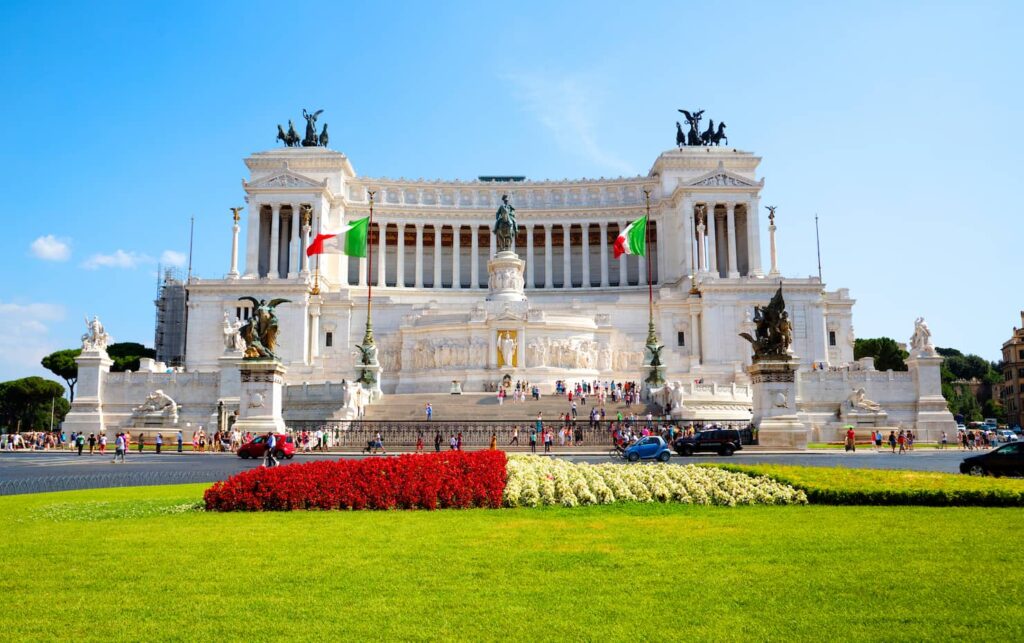
Piazza Venezia is located at the foot of the Campidoglio. Concentrated in this meeting point of the Pigna, Campitelli and Trevi districts are some of the symbolic places of Italian history of the 1800s and 1900s.
These are the Vittoriano, Palazzo Venezia, and Palazzo Bonaparte (not open to the public), which belonged to Maria Letizia Ramolino, Napoleon‘s mother.
Originally called St. Mark’s Square because of its proximity to the church named after the evangelist, it later assumed the name of St. Mark’s Basin Square.
The current and final name dates back to 1560 when Pope Pius IV donated the area and the palace that insisted on it to the Republic of Venice as the seat of its diplomatic embassy in Rome.
The Vittoriano
ID 125748117 | Of © Anton Aleksenko | Dreamstime.com
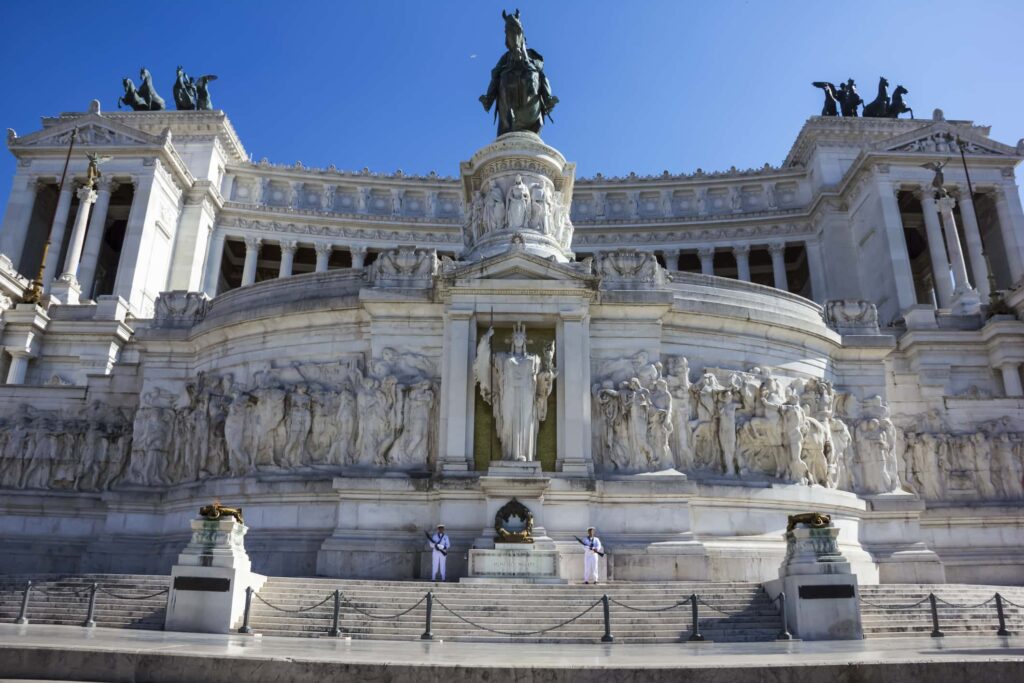
The Vittoriano, also known as the Victor Emmanuel II Monument, is one of the national patri symbols because it focuses on the celebration of theUnification of Italy.
It was designed by Giuseppe Sacconi, begun in 1885, inaugurated in 1911 to celebrate the fiftieth anniversary of the Unification of Italy, and finally completed in 1935.
Inside it encloses theAltare della Patria, another name by which the monumental complex is designated, and since 1921 also the tomb of the Unknown Soldier.
It is the site of the celebrations of April 25 (Liberation Day), June 2 (Republic Day) and November 4 (National Unity and Armed Forces Day) in the presence of the President of the Republic and the highest state officials.
Venice Palace
ID 69244801 | © Juergen Schonnop | Dreamstime.com
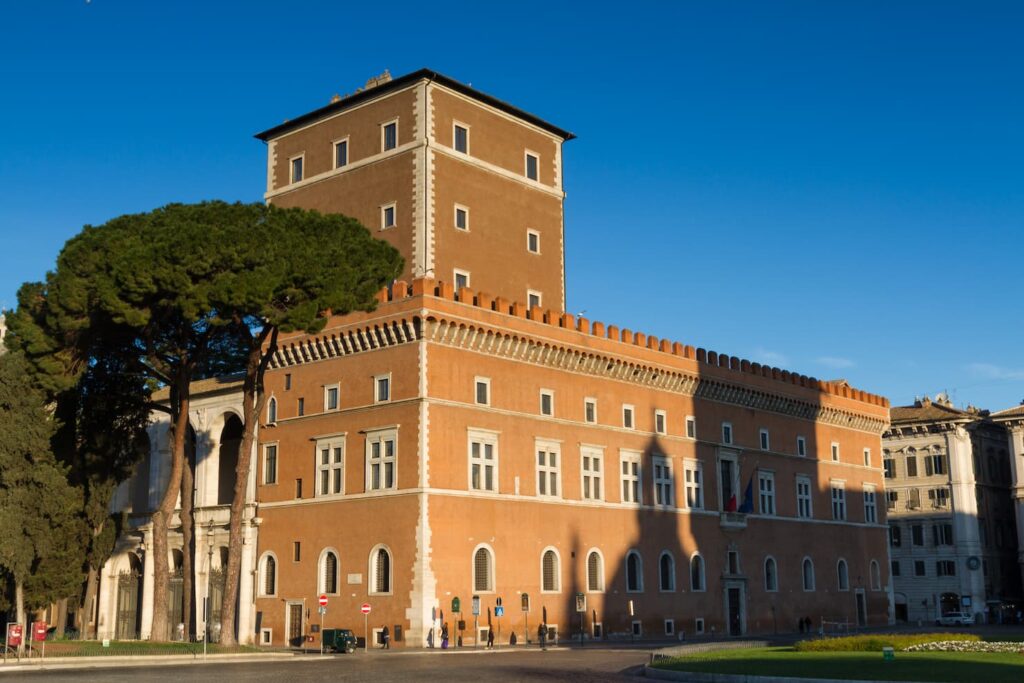
Built in the mid-15th century by Cardinal Pietro Barbo, Palazzo Venezia is an important building in Roman history. It takes its name from the gift made by Pope Pius IV to the Republic of Venice to house its ambassadors to the Holy See.
In 1929, Benito Mussolini made it his headquarters, and from here he announced to the crowds thronging Piazza Venezia the birth of theEmpire in 1936 and the declaration of war on France and Britain that decreed Italy’s entry into World War II on June 20, 1940.
Today it houses the National Museum of Palazzo Venezia, where works by Bernini stand out, and a specialized library that makes it a world reference for the study of the History of Archaeology and the History of Art.
Church of St. Ignatius of Loyola

ID 372122618 | Of © Angelo Calvino | Dreamstime.com
Dedicated to the founder of the Society of Jesus, the church of St.Ignatius of Loyola is an absolute masterpiece of Baroque art.
Begun in 1626 and opened in 1650, the church is famous for Andrea Pozzo’s illusionistic paintings, especially “The Glory of St. Ignatius” and the mock dome.
If you decide to visit, the signs on the floor will allow you to position yourself in the exact spots to grasp and appreciate the perspective plays created by the great Jesuit painter, architect and decorator.
The church is also important for the tombs of three saints of the Society of Jesus housed inside. They are Luigi Gonzaga, Robert Bellarmine and John Berchmans.
Church of Jesus
ID 313854032 | © Yury Morozov | Dreamstime.com
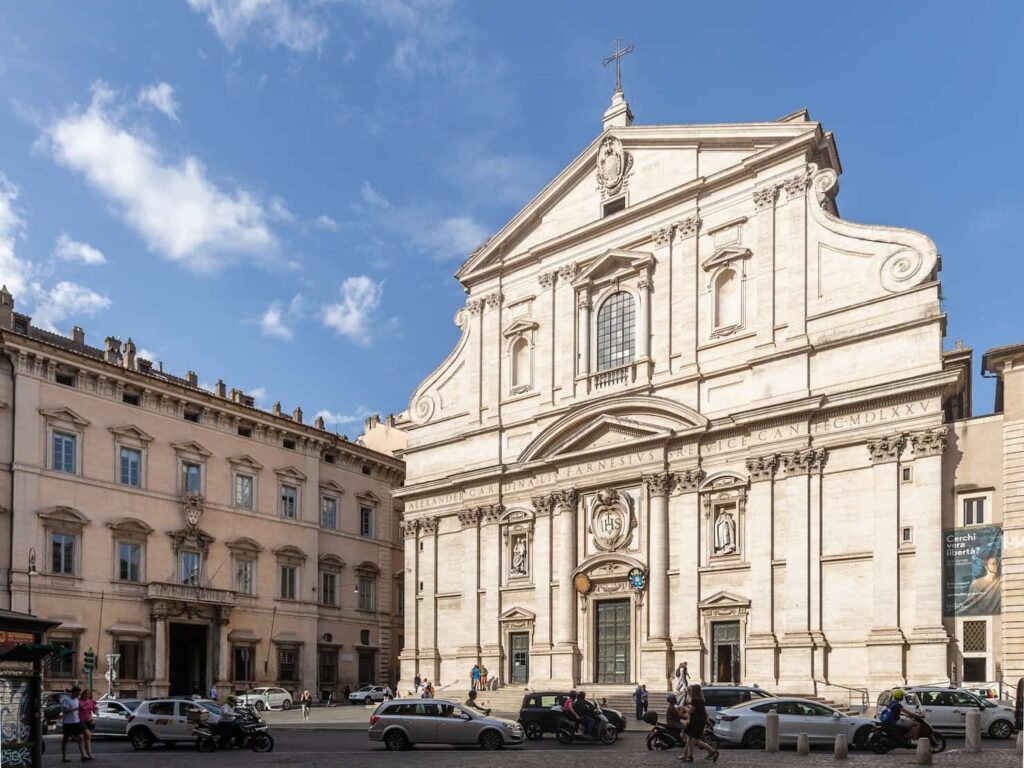
There are several ways to refer to this very important religious building in the Pigna district: Church of the Most Holy Name of Jesus, Church of Jesus, or simply the Jesus.
Builtbetween 1568 and 1580, its architecture is inspired by the principles of the Council of Trent and is in this respect a model for other buildings built by the Jesuits in many parts of the world.
The floor plan, designed by Vignola (but Michelangelo had also had a hand in it earlier) has a single nave, so that all the attention of the faithful is focused on the altar.
The facade and dome were designed by Giacomo Della Porta. Of high artistic value is the central vault fresco, “Triumph of the Name of Jesus,” by Baciccia.
Map with attractions near the Pantheon
Here is a map with the 21 monuments and attractions near the Pantheon that you can visit on a wonderful walk in the Eternal City.
FAQ about attractions near the Pantheon in Rome
Rome was not built in a day and you cannot visit it all in three. You have to make choices, but you can’t miss in no particular order: Colosseum, Castel Sant’Angelo, Pantheon, Vatican Museums, St. Peter’s Basilica, Trevi Fountain, Piazza Navona.
To the list we proposed above we can add the Baths of Caracalla, the Via Appia Antica, the Papal Basilicas (St. Mary Major, St. Paul, St. John Lateran), the Catacombs, and the Domus Aurea.
The Pantheon and the Colosseum both date from the second century AD. The Flavian Amphitheater was inaugurated in 80, the Hadrianic temple some 40 years later. Yet the Pantheon has a longer history, because it was rebuilt on the remains of a building dating back to 27 BCE. The Pantheon, therefore, can be considered older.
The Colosseum is the symbolic monument of the capital city and for this reason it can be considered the most important.
Conclusions
We have come to the end of this article, which you can consider the beginning of your journey of discovery of Rome’s historical, artistic and cultural heritage.
Given the quantity and quality of monuments in the capital, we have limited ourselves to those that you cannot miss under any circumstances, especially if you are visiting the city for the first time or you want your children or foreigners to discover it.
From the Pantheon to the Colosseum, from Castel Sant’Angelo to the Vatican, from Piazza Navona to the Trevi Fountain, some of Italy’s most famous and important art treasures can be visited within a few hundred meters.
Set out now and take a deep breath. You’ll need it when the beauty of Rome takes your breath away.
The best-selling ever
Pantheon of Rome: Quick Access Ticket + Official Audio Guide
Quick access and audio guide included: discover the history of the Pantheon and admire the famous dome and oculus.
Secure payment
Instant confirmation
Mobile ticket
